Plug-in Solar vs. Community Solar: Which Is Better for Renters?
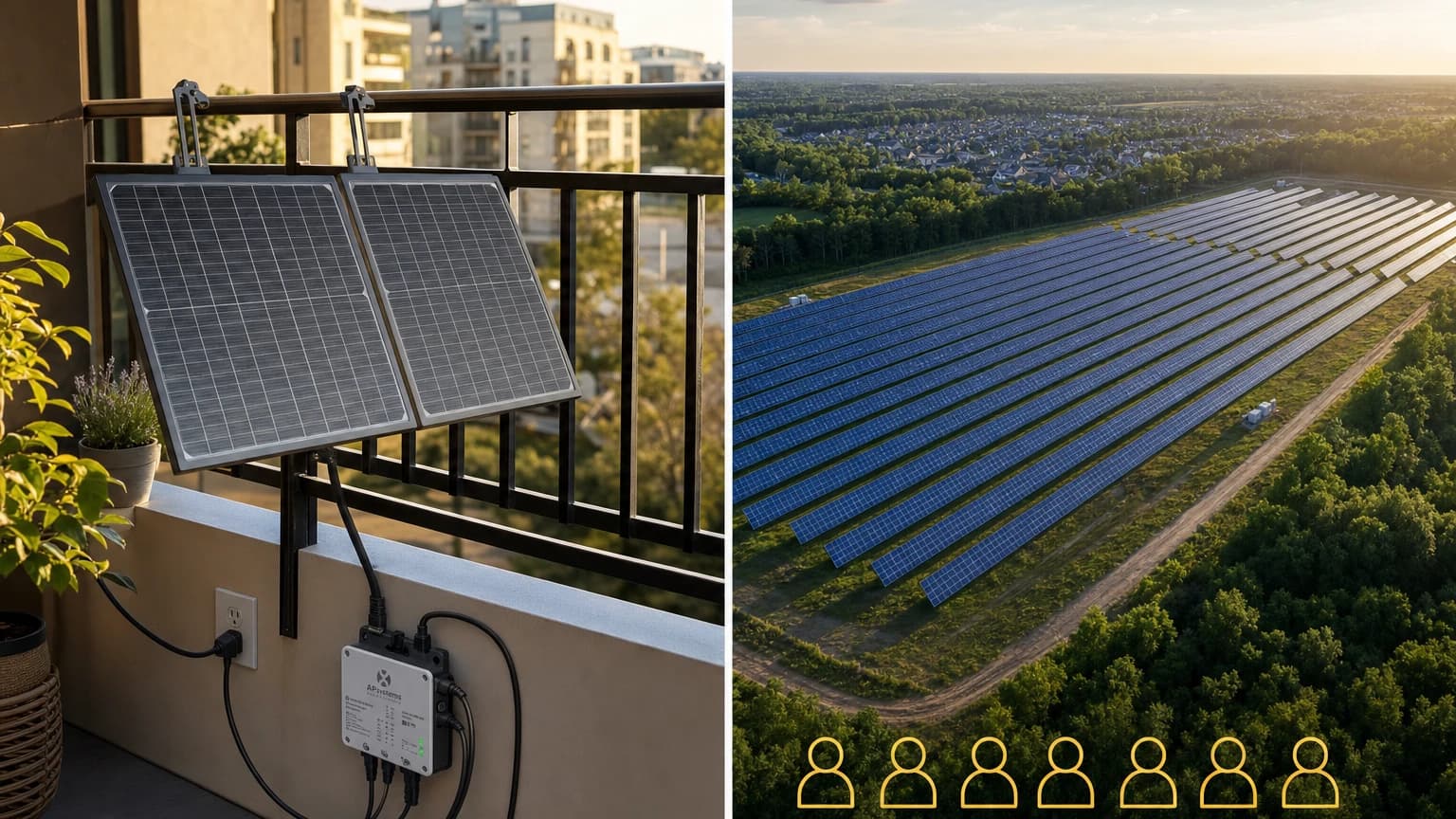
Renters comparing plug-in solar and community solar will find that neither option is universally better. Plug-in solar means buying a physical panel kit, plugging it into your wall, and owning the equipment outright. Community solar means subscribing to a share of an off-site solar farm and getting credits on your electricity bill with zero installation. The right choice comes down to where you live, whether you have outdoor space, and how often you move. This guide lays out both options with real numbers so you can pick the one that works for your situation.
What Is Community Solar and How Does It Work?
Community solar lets you subscribe to a share of a solar farm in your utility's service area and receive credits on your electricity bill for your portion of the energy it produces. No panels on your property. No installation required. Most programs offer a 5–15% discount on your utility rate with no upfront cost.
The credits work through a mechanism called virtual net metering. Each month, your share of the farm's output gets converted into a bill credit at your utility's rate. At the national average electricity rate of 17.65¢/kWh (EIA, April 2026), that's roughly $8–$25 per month in savings for a typical apartment.
By the end of 2025, community solar had surpassed 10 GW of operational capacity across the US. Programs exist in approximately 44 states, with formal enabling legislation in 24 states. The biggest markets are New York, Massachusetts, Minnesota, and Florida. Most residential programs have no upfront cost, no credit check, and cancellation with 30–90 days' notice.
Before signing, though, there's one restriction that catches community solar renters by surprise: subscriptions are tied to your current utility's service territory. Move to a different city served by a different utility and your subscription ends — you'd need to cancel, re-enroll somewhere new, and possibly join a waitlist.
What Is Plug-in Solar and Who Can Use It?
Plug-in solar is a physical solar panel kit you own, connect to a microinverter, and plug into a standard wall outlet. Your panel generates electricity that flows directly into your home's wiring, reducing what you draw from the grid in real time. You see the savings on your monthly bill.
A typical 800W kit costs $800–$1,400. Kits from brands like Craftstrom and EcoFlow tend to land in the middle of that range, around $900–$1,100. An 800W system produces roughly 80–120 kWh per month, saving around $14–$21 at the national average rate. In higher-rate states like California or Hawaii, the same system saves $24–$52 per month. Most renters start with the Standard tier (800W, two panels), enough to offset 15–25% of a typical apartment's electricity use. Use our free savings calculator to see what your setup would save based on your address and electricity rate.
Plug-in solar kits are portable. When you move, they come with you. You own the equipment, which means you may qualify for the federal residential clean energy tax credit (Section 25D), which cuts your income taxes by 30% of the purchase price. A $1,000 kit effectively costs $700 after the credit. Community solar subscribers own nothing and can't claim this credit.
The main requirement is outdoor space with sun access. A balcony, patio, or porch that gets a few peak sun hours daily is enough. You also need your landlord's permission in most states, though five states (Utah, Virginia, Maine, Maryland, and Colorado) now legally prohibit landlords from blocking tenants who want to install a UL-certified plug-in system. Virginia signed that protection into law in April 2026 with a unanimous 96–0 Senate vote.
Many modern plug-in systems also use zero-export technology, which matches production to your home's real-time consumption and never sends electricity back to the grid. That removes the utility interconnection requirement in most states, even outside the five with explicit renter protections.
How Do Plug-in Solar and Community Solar Compare on Cost?
The table below covers eight dimensions renters actually care about before deciding.
| Plug-in Solar | Community Solar | |
|---|---|---|
| Upfront cost | $400–$1,400 (30% tax credit available) | $0 |
| Monthly savings | $14–$52/month (varies by rate and sun) | $8–$25/month (5–15% discount) |
| Payback period | 3–7 years | None — subscription, not purchase |
| Contract | None — you own it | 12–25 months typical |
| Portability | Yes — panels move with you | Within utility territory only |
| Landlord permission | Required in most states (protected in 5) | Not required |
| State availability | Legal/protected in 5 states; 28+ bills pending | Programs in 44 states; legislation in 24 |
| Federal tax credit | Yes — 30% of purchase price | No |
The financial picture tells a different story depending on your timeline. Community solar costs nothing upfront, which makes it easy to start, but you never own anything and the savings cap around 15%. Plug-in solar requires an upfront investment, but once paid off, you're generating free electricity for the remaining 20+ year lifespan of the panels.
Consider two renters in Massachusetts, where electricity runs about 28¢/kWh. The community solar subscriber saves roughly 15% — about $30/month and $360/year — with no money down. The plug-in solar owner with an 800W system saves roughly $27/month and $325/year. After the 30% tax credit, the kit costs around $840, putting payback at about 2.5 years. After that, the savings keep running for another two decades.
Run your own numbers with our free savings calculator, which uses your zip code, electricity rate, and local sun hours to produce a personalized estimate.
The Hidden Catch with Each Option
Community solar and plug-in solar both look simple until you read the fine print.
With community solar
The utility territory restriction is the one most renters don't anticipate. Community solar subscriptions are built around your current utility's virtual net metering system. Move across town within the same utility's coverage and you're fine. Move to a different city served by a different utility, and your subscription ends. Renters move more often than homeowners — and frequently cross utility boundaries when they do.
Some high-demand states like Illinois and New York also have waitlists. You may sign up and wait several months before credits start appearing on your bill.
With plug-in solar
You need a suitable outdoor space. A north-facing balcony with heavy shading won't produce meaningful output. You also need permission from your landlord in most states, and while asking your landlord goes better than most renters expect, it's still an extra step. In states without explicit legal protection, a landlord can say no. Check your state's current laws before buying equipment.
The permit question tends to be simpler than it sounds. In states with plug-in solar legislation — and with zero-export-capable systems in most others — you typically don't need a utility permit. The UL 3700 safety standard launched in January 2026 as the first US certification built specifically for plug-in solar systems. A UL-certified system eliminates the main objections from landlords and insurers alike.
Which Is Better for Renters: Plug-in Solar or Community Solar?
Work through these four questions to find your answer.
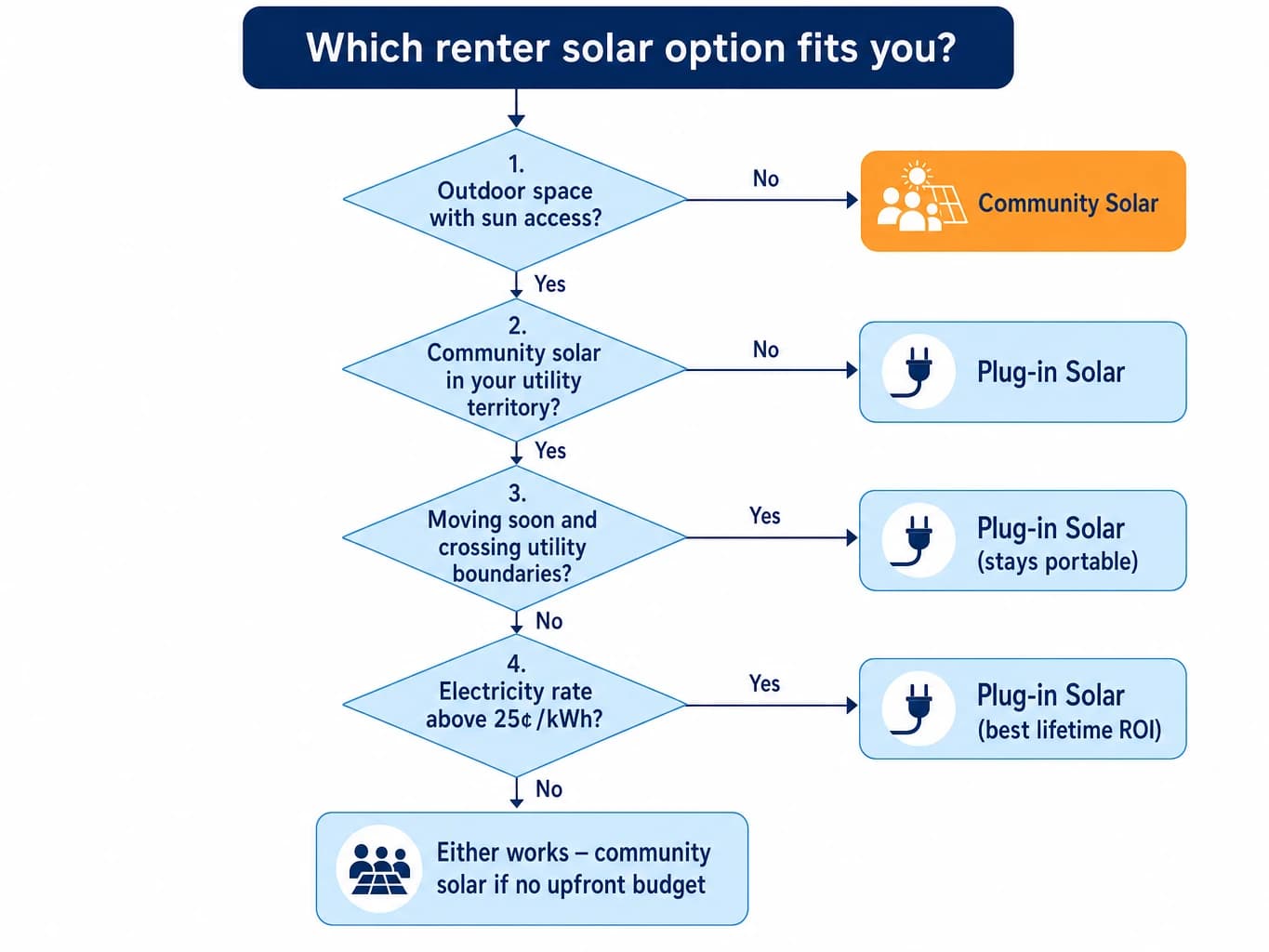
1. Do you have usable outdoor space with sun access?
If no — a north-facing balcony, a windowless unit, or no outdoor access at all — community solar is your only real option. Plug-in solar needs direct sunlight to produce anything meaningful.
2. Is community solar available in your utility's service territory?
About 20 states lack community solar legislation as of May 2026. If you're in one of them, plug-in solar is the clearer path. If programs are available but waitlisted, sign up and install a small 400W starter kit in the meantime.
3. How often do you move, and do you cross utility boundaries?
If you move every year or two and frequently change cities, plug-in solar's portability matters. A panel kit moves with you and keeps producing wherever you land. A community solar subscription resets if you leave your utility's territory.
4. What's your electricity rate?
Above 25¢/kWh — California, Hawaii, Massachusetts, Connecticut, Rhode Island — plug-in solar often pays back in 2–4 years and generates significantly more lifetime savings than community solar. Below 12¢/kWh in parts of the South and Midwest, the payback stretches and community solar's no-cost-to-start model becomes more attractive. See the full payback analysis with state-by-state breakdowns.
For most renters, the solar for renters comparison comes down to one of four situations:
No outdoor space, stable address
Community solar is the straightforward choice.
Balcony + high electricity rate + staying 2+ years
Plug-in solar wins on lifetime savings.
Moving frequently
Plug-in solar's portability is the decisive factor.
No community solar in your state
Plug-in solar (or a portable power station for backup) is your path.
Can You Use Both?
If you have a balcony and live in a state with community solar, you don't have to choose. Some renters subscribe to community solar for baseline bill savings while running an 800W plug-in kit for direct ownership and a higher offset. The subscription reduces your base rate; the balcony solar system offsets your highest-use hours. It's not common yet, but it's gaining traction in high-rate states where every percentage point of savings adds up.
One thing to watch: some community solar contracts include clauses that reduce your credit if your metered consumption drops significantly. Check the contract terms before layering systems. If you want to add battery backup to your plug-in system to store daytime solar for evening use, see whether a battery makes financial sense before adding that cost.
Whichever side of the plug-in solar vs. community solar question makes more sense for your situation, start by checking what's legal and available where you live. Browse plug-in solar kits in our product catalog.
Frequently Asked Questions
Common questions from renters comparing plug-in solar and community solar.
Ready to see what plug-in solar would save you?
Enter your zip code and monthly electricity bill. Our calculator uses real solar data for your location to estimate your savings alongside your state's current legal status.
Last updated: May 4, 2026. State laws and community solar program availability change frequently. We review this page quarterly and update state-specific information as new legislation takes effect.