Products
Do You Need a Battery with Plug-in Solar?
No battery required. You can run a working, money-saving plug-in solar system without one — and many renters and apartment dwellers do exactly that with solar panels for apartments, plugging their balcony solar panel into a standard outlet and letting the grid handle the storage for free.
Plug-in solar with battery storage unlocks something different: backup power during outages, the ability to shift energy to evening hours, and the option to run your essentials without drawing from the grid. Whether that's worth paying more is a sharper question than it looks.
This guide walks you through the actual decision: when balcony solar battery storage makes financial sense, which systems work in apartments, and when more panels are the better buy.
Disclosure: Some links in this article are affiliate links. If you purchase through them, we may earn a small commission at no extra cost to you. Read our full disclosure →
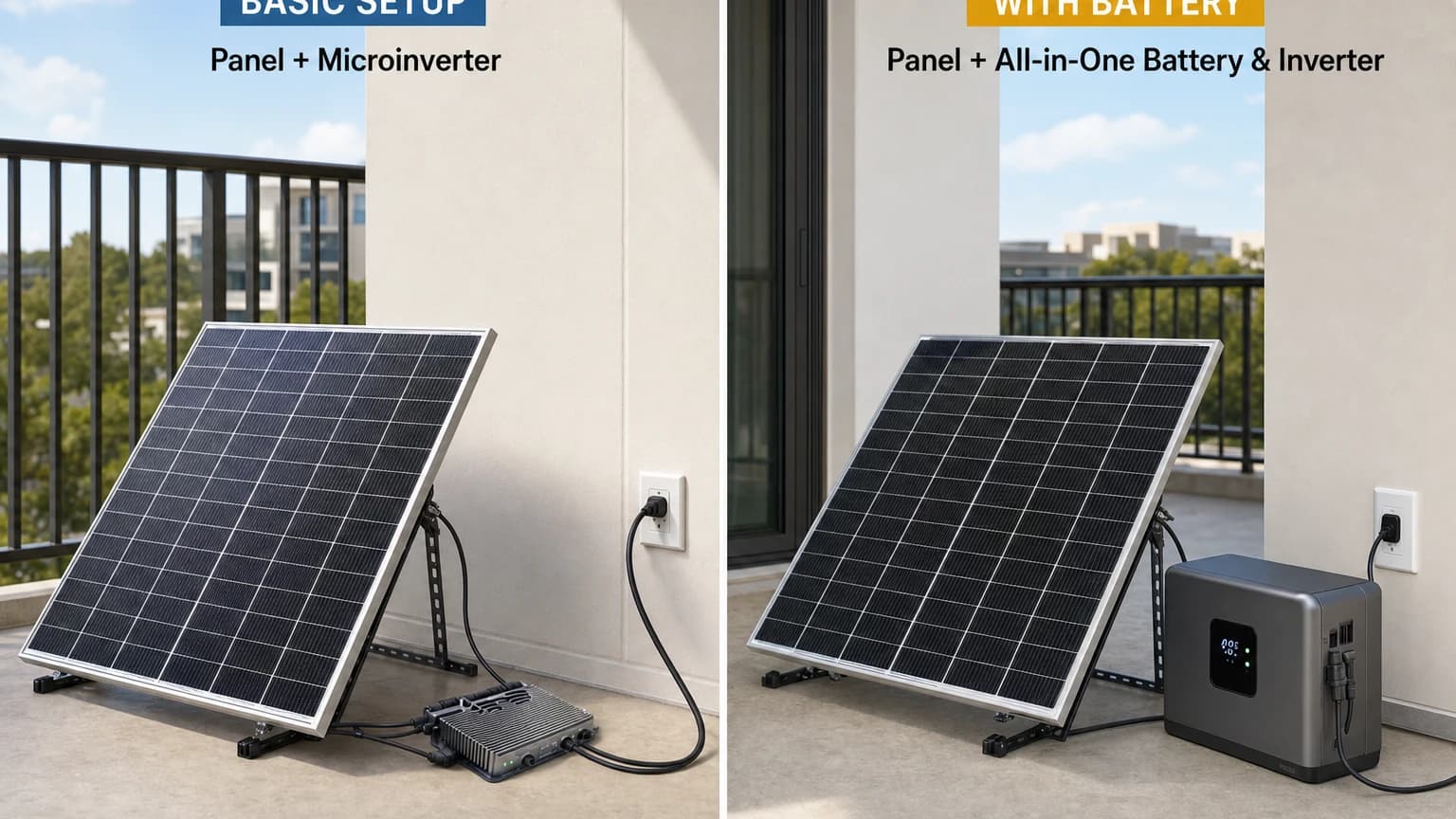
Do you actually need a battery with plug-in solar?
No. A battery is optional, not required. A basic plug-in solar system works perfectly fine without one. Your panel connects to a standard outlet via a certified microinverter, sends power to your appliances first, and any excess electricity flows to the grid. In states that allow plug-in solar, you get credited for that excess through net metering. No battery needed, no backup power, no extra complexity.
How plug-in solar works without a battery
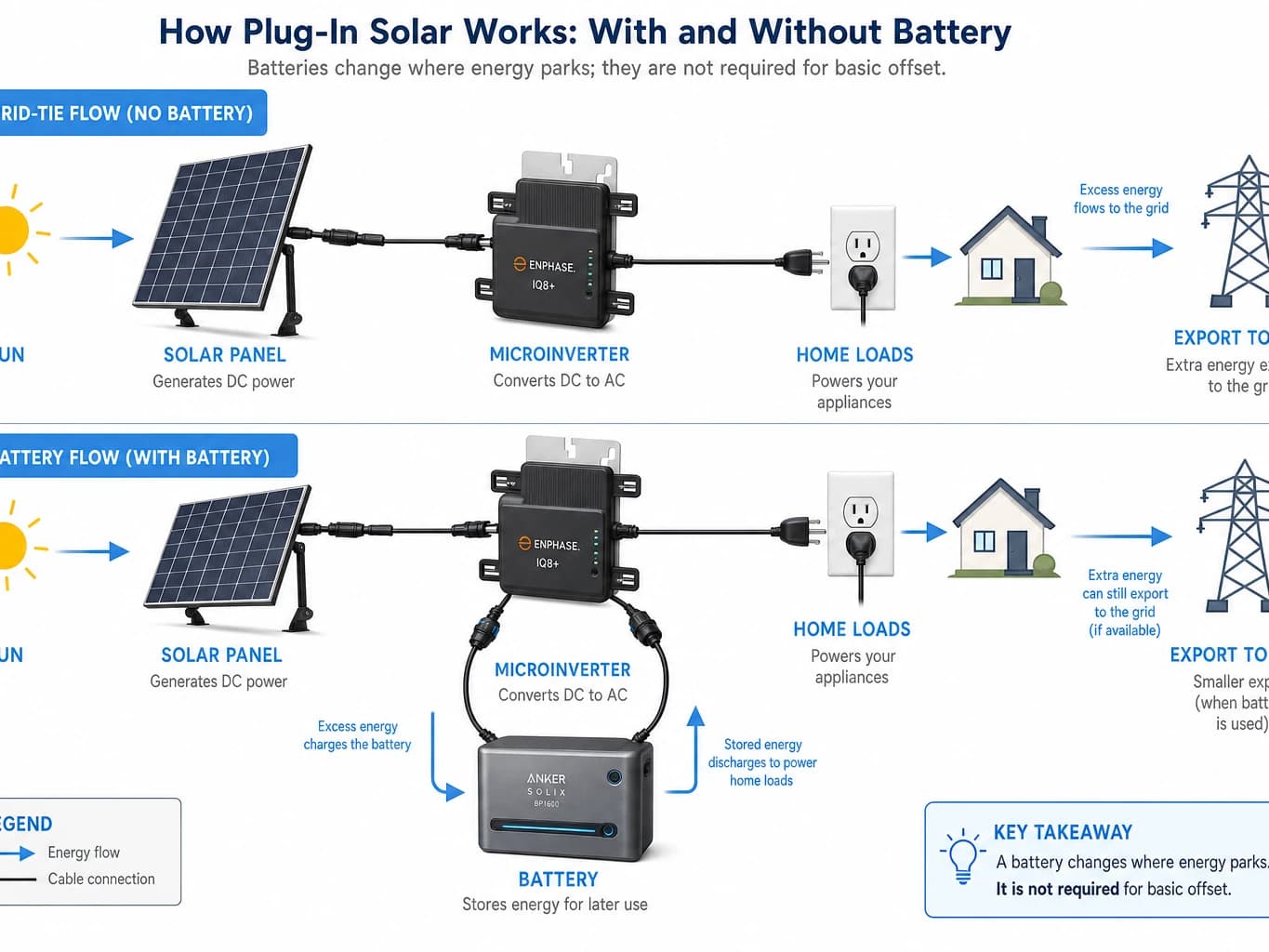
When you plug in a standard plug-in microinverter, here's what happens: your solar panel generates DC electricity during the day. The microinverter converts it to AC power that matches your home's electrical standard. That AC power goes directly to your appliances — your laptop, your coffee maker, the TV, anything that's on. If you're using more power than your panel is making, the grid fills the gap automatically.
This is the most affordable route to getting started with balcony solar panels for renters: $400–$1,500 for a complete plug-and-play solar starter kit (solar panel, microinverter, cables, mounting hardware). No battery, no extra wiring, no electrician. Just plug in and start saving.
See what's in that starter kit box in our breakdown of what you're starting with.
What happens during a power outage if you don't have battery storage?
Anti-islanding: the one catch
When the grid goes down, your solar panel shuts off automatically, even in bright sunlight. This is mandatory under the IEEE 1547 anti-islanding standard and applies to every grid-tied inverter sold in the US. These inverters shut down within 1–2 seconds of detecting grid loss so they won't back-feed power into utility lines while workers are repairing them. Read more in our plug-in solar safety guide.
For most households, this is a reasonable trade-off. EIA data shows the average US customer experienced about 5.5 hours of power outages in 2023, mostly from brief weather events. Daily solar savings compound fast enough that a 10-hour annual outage rarely justifies a $1,500 battery on its own.
If you work from home and can't absorb a 4-hour blackout, or if your area sees multi-day outages from hurricanes or ice storms, a battery changes the calculus.
When does adding a battery make sense?
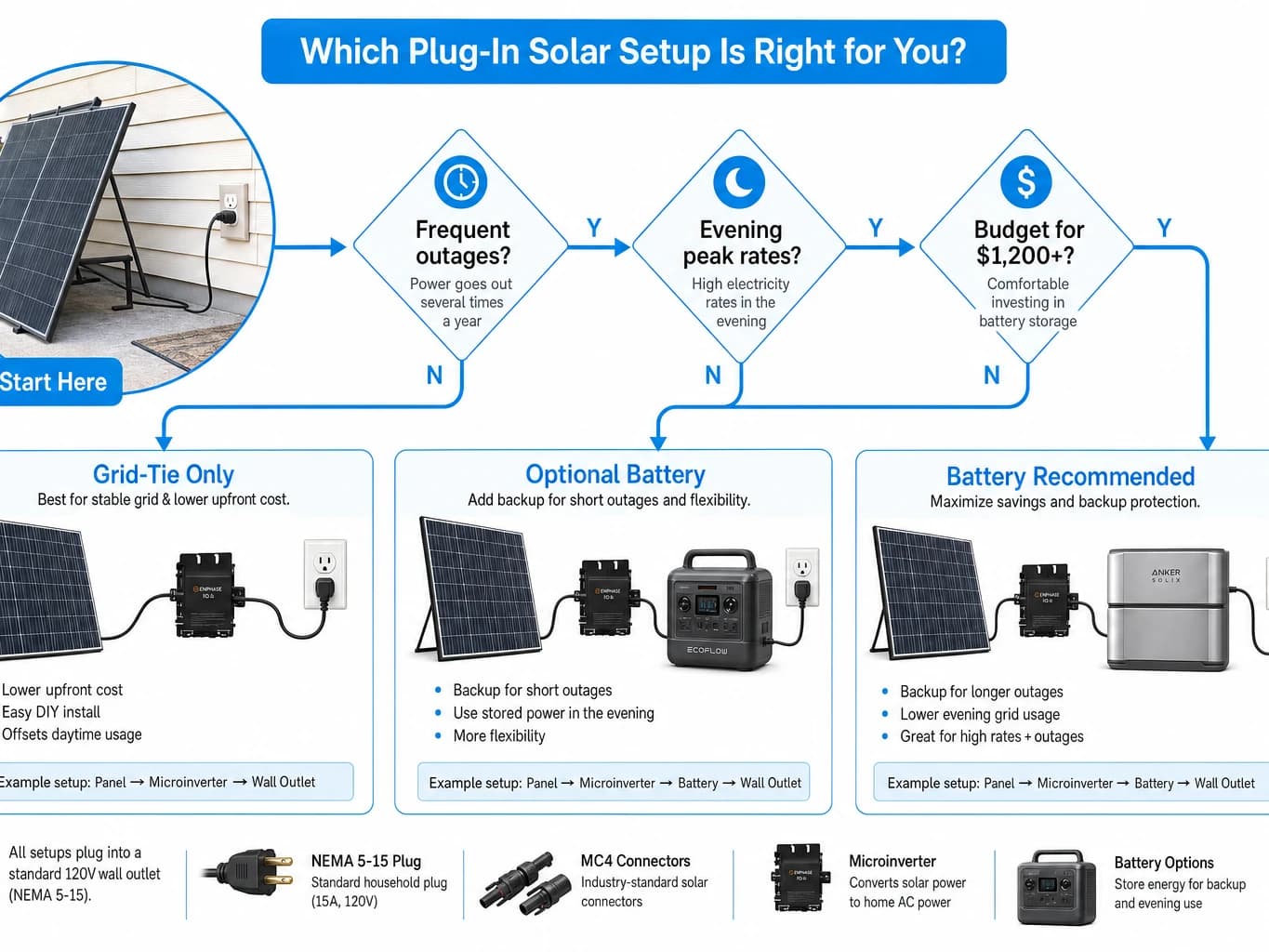
Scenario 1: You want backup power during outages
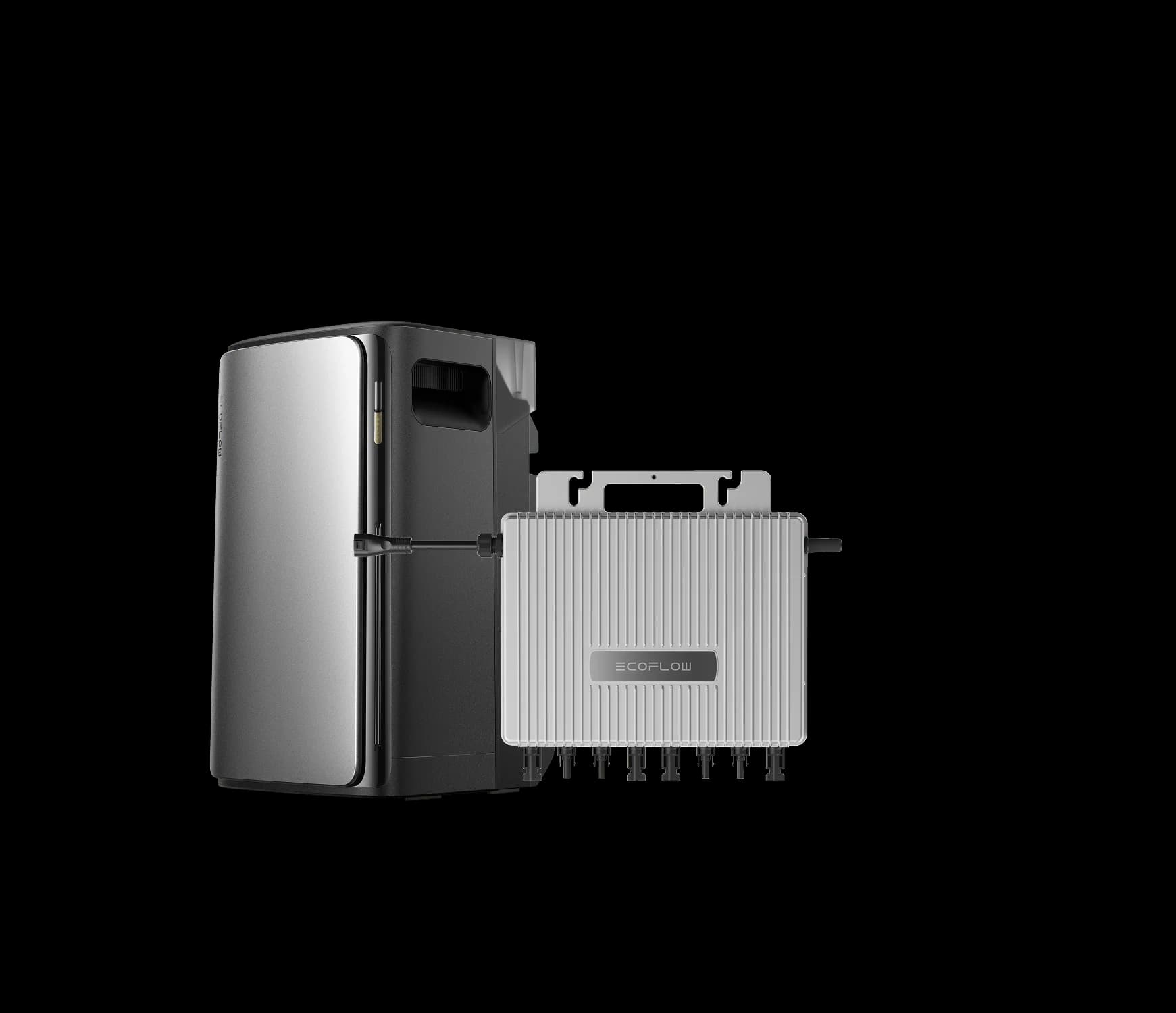
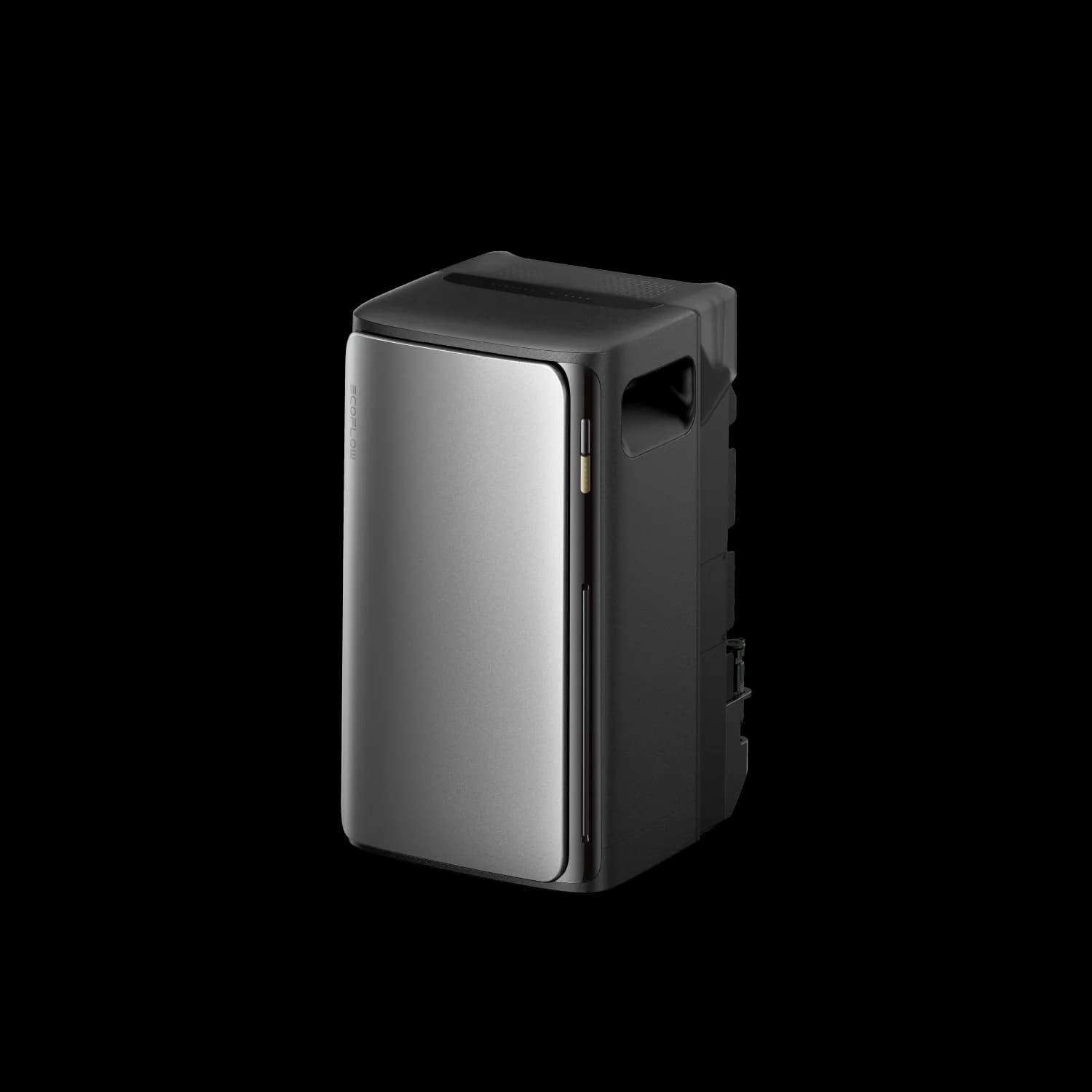
A 1–2 kWh plug-and-play solar battery like the EcoFlow STREAM Ultra won't run your whole house, but it covers the essentials: phone charging, LED lighting, a fan, and a fridge cycling for several hours. Scale up to 5–10 kWh and you can run most appliances for half a day. The question is whether that reliability is worth $1,200–$3,500 upfront.
Scenario 2: Your electricity use peaks in the evening
At work all day, heavy use from 6–11 PM? A battery lets your panels charge it during the day; you discharge it at night instead of buying expensive peak-rate electricity. High time-of-use rates in California, New York, and Hawaii make this math considerably more favorable.
Scenario 3: You can't use net metering
If your utility doesn't credit exported power, a battery can keep more of your own solar production in your home. It stores daytime output for evening use instead of sending it away for little or no value. Check your utility rules before you pay for storage: a smaller system that matches your daytime use can still be the better value.
Scenario 4: Your state has battery incentives
California's SGIP rebate and New York's CSEA program have historically covered $200–$1,000 per kWh of battery storage. Massachusetts offers incentives through the SMART program as well. These can trim 2–4 years off a battery's payback timeline.
Our pick by scenario
Outage backup
Choose an integrated battery system when keeping a fridge, lights, and devices running matters more than the fastest payback.
Evening bill shifting
Storage makes the most sense where time-of-use electricity is costly after sunset.
No net metering
Consider a battery only after confirming your utility won't fairly credit exported solar power.
Compare battery and grid-tie options
EcoFlow STREAM is currently sold for plug-in use in Utah and Maryland. Elsewhere, use this table as a product comparison, then confirm your state and utility rules before you buy.
Batteries don't make financial sense if:
- ×Your electricity rate is below $0.12/kWh
- ×Your roof or balcony gets fewer than 4 peak sun hours daily
- ×Grid outages are rare where you live
- ×You'd rather invest that $1,500 in a second or third solar panel
How much do solar batteries cost?
We may earn a commission when you purchase through these links — it doesn't affect the price you pay. See our full disclosure →
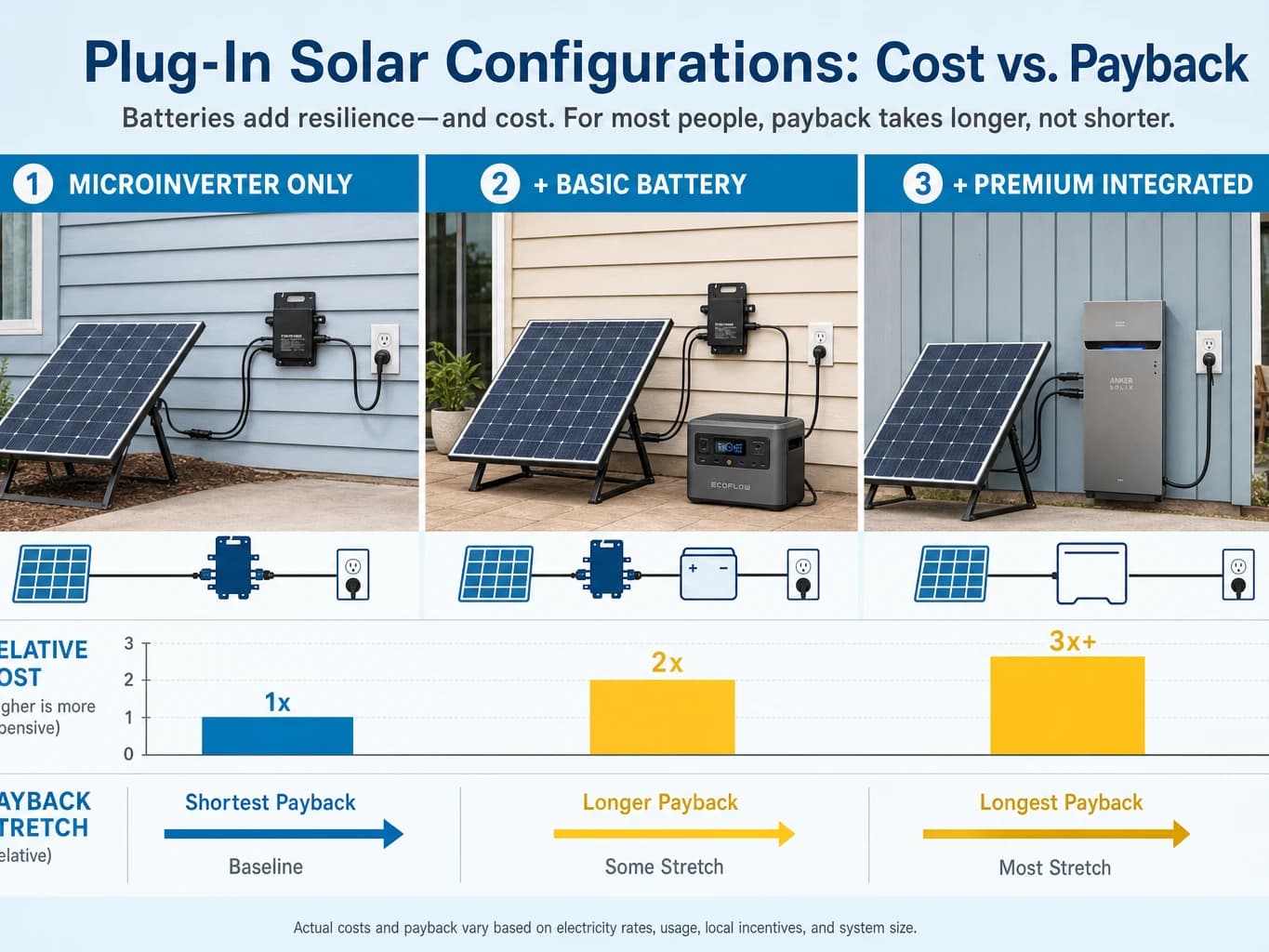
Here's the real math.
Battery-only cost: $300–$800 for a 1 kWh battery (Zendure SolarFlow AB1000S, ~$650). $1,200–$2,000 for 2–3 kWh (multiple units). Modular: you can add more later.
Integrated battery + inverter: Compare the live price of EcoFlow STREAM Ultra (1.92 kWh, all-in-one). Check its live price in the comparison table because promotions and stock change. It is simpler to install but less modular — you can't swap batteries without replacing the full unit.
Installation and hardware: $200–$600 (cables, mounting brackets, possibly a dedicated circuit for multiple units). DIY eliminates this cost.
| Configuration | Total Cost | Payback Period |
|---|---|---|
| Grid-tie only (400W) | $500–$1,000 | 3–5 years (national average rate) |
| Grid-tie + 1 kWh battery | $1,200–$1,800 | 5–7 years |
| Grid-tie + 2 kWh battery | $1,800–$2,500 | 7–9 years |
| Grid-tie + STREAM Ultra (1.92 kWh) | See live price below | 4–6 years (high-rate states) |
Batteries pay off faster in high-rate states. In California at $0.28/kWh (EIA 2025), adding a $900 battery to an 800W system stretches payback from 3–4 years to 5–6 years — barely worth it without time-of-use pricing. In Hawaii at $0.39/kWh, battery payback is a more reasonable 4–5 years because evening power shifting is genuinely valuable. In mid-to-low rate states like Colorado at $0.16/kWh, an extra panel almost always delivers better return than battery storage.
For a deeper look at how plug-in solar stacks up over time, see our full payback period analysis.
Popular battery systems for plug-in solar
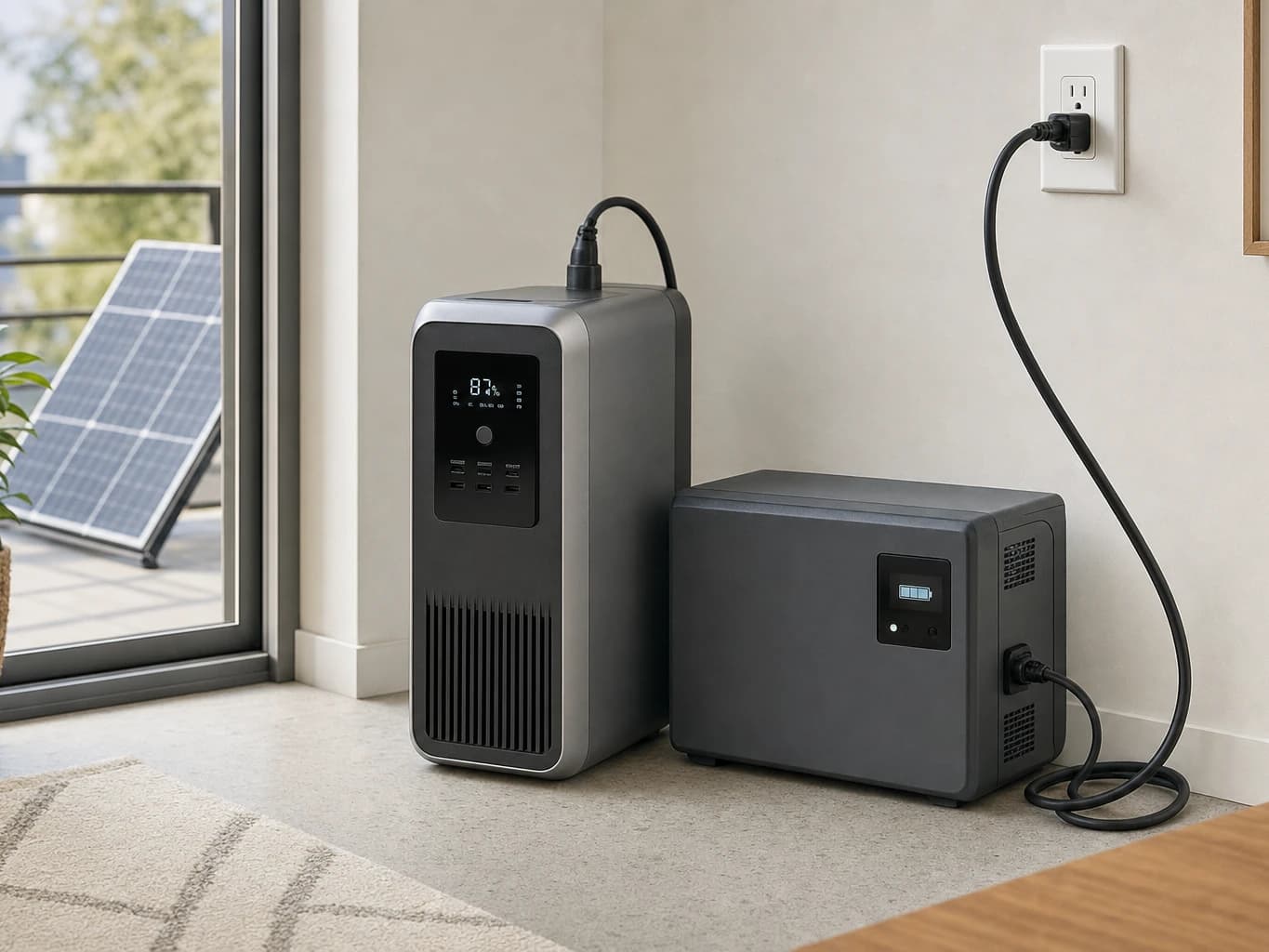
EcoFlow STREAM Ultra
One compact unit: a 1.92 kWh battery and hybrid microinverter combined in a device roughly the size of a large toaster (255×284 mm). You plug it into a 120V outlet, connect your solar panel, and it handles everything else — with two AC outlets for running two appliances simultaneously.
Power output: up to 800W sustained, 1,200W peak. EcoFlow claims annual generation of approximately 6,424 kWh at ideal sun exposure and potential annual savings of ~$1,027 (treat those figures as a best-case ceiling, not a typical result). Cost: €1,299–€1,499 (~$1,400–$1,600 USD in early 2026). Capacity is expandable to 11.52 kWh by stacking compatible battery units.
Best for: renters who want the simplest possible setup and don't already own a separate microinverter.
Zendure SolarFlow Kit
Modular design: battery units (AB1000S, ~$650 per 1 kWh) connect to a hub/inverter (~$400 one-time). Compatible with 99% of solar panels and most grid-tied microinverters (Hoymiles, APsystems, Enphase). Stack up to five units for 5 kWh total.
If you bought a non-integrated microinverter a year or two ago, you can add Zendure storage without replacing anything. More components to manage than EcoFlow, but you're not starting from scratch.
Best for: buyers upgrading an existing grid-tie setup who want to add storage without replacing working hardware.
Both systems use LiFePO4 (lithium iron phosphate) chemistry, the same technology in most long-life portable power stations, with manufacturer-rated lifespans of 5,000–10,000 cycles — roughly 15–25 years of daily use at 90%+ efficiency.
Frequently Asked Questions
Common questions about plug-in solar batteries, backup power, and storage options.
See which system makes sense for your address
Enter your zip code and monthly electricity bill. Our calculator uses real solar data for your location to estimate your savings — with and without battery storage.
Last updated: August 1, 2026. Information on this page is reviewed quarterly for accuracy.