What Is Zero-Export Solar and Why Renters Don't Need Utility Approval
If you're a renter interested in solar, you've probably hit a wall: rooftop systems need permanent installation and landlord approval, traditional grid-tied systems require utility interconnection agreements, and portable power stations seem expensive for what you get. Zero-export solar removes all three barriers at once.
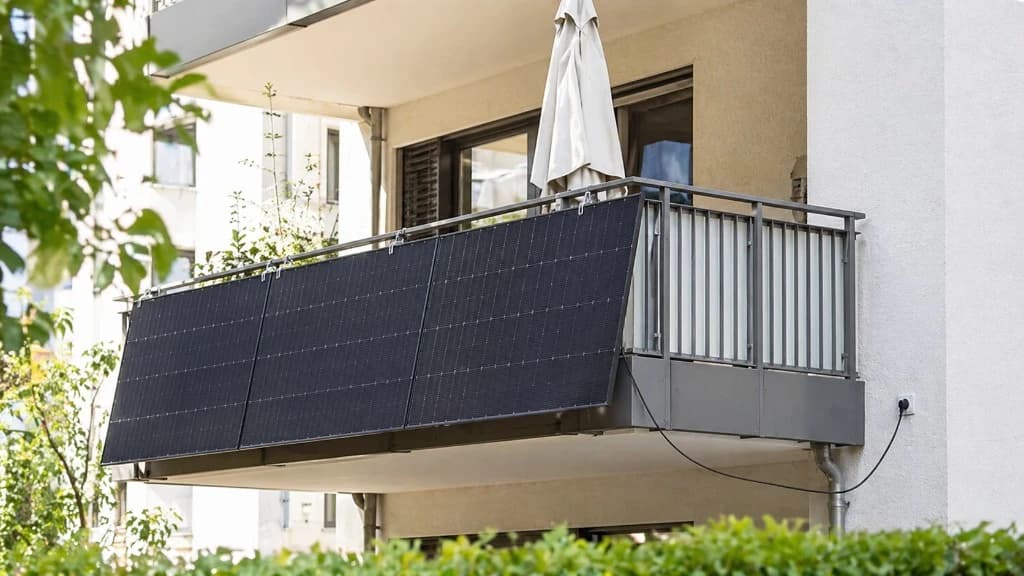
What Is Zero-Export Solar?
Zero-export solar means your system produces electricity only for immediate use in your home. Any power you don't consume right now is not sent back to the grid — it's simply not produced. The system continuously monitors your home's actual power consumption and adjusts its output to match, every second.
This is the opposite of traditional grid-tie solar, which generates at full capacity and automatically exports excess power. Zero-export systems actively prevent backfeed by throttling (reducing) the microinverter's output whenever your home consumption drops below solar production. If you add an optional battery, that surplus energy gets stored instead of curtailed, and drawn back down at night or whenever your home needs more power than the panels are generating.
Zero-export systems are fundamentally different from standard grid-tie plug-in solar. They're designed to consume every watt you generate on-site — zero watts go back to the grid. For renters, this eliminates the utility approval bottleneck that blocked plug-in solar for years. As of early 2026, clean energy policy groups tracked over 50 active bills across 29 states and DC legalizing plug-in solar, and our state legality guide tracks where compliance paths are opening up. The compliance mechanism in almost every one: zero-export design.
How Does Zero-Export Solar Work?
- A CT clamp on your electrical panel reads your home's exact power consumption in real time.
- The clamp transmits that reading wirelessly to your microinverter every 1–2 seconds.
- The microinverter adjusts its output to match — producing only what you're currently using, nothing more.
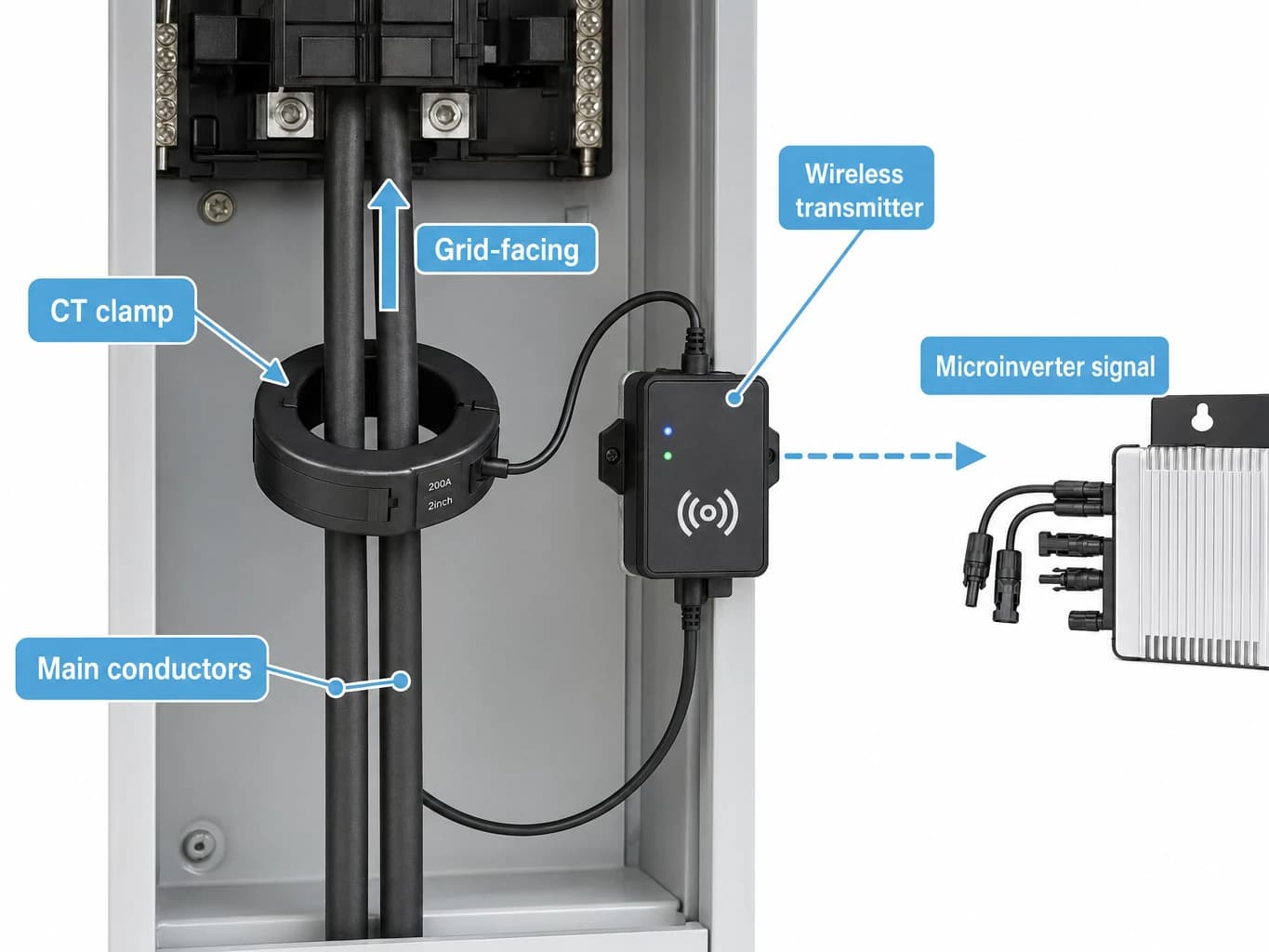
The key component is the current transformer (CT) clamp — a small sensor that wraps around your main electrical panel's conductors. Here's the sequence: Your solar panel produces 400 watts. The CT clamp detects that your home is using only 300 watts (AC, lights, refrigerator — everything running right now). The clamp sends a wireless signal to your microinverter saying “reduce output to 300 watts.” It obeys within 1–2 seconds. Zero watts go to the grid. No backfeed. No problem.
If someone turns on a space heater and your home's consumption jumps to 500 watts, the clamp detects it and tells the microinverter to ramp up to 500 watts (or the panel's maximum, whichever is lower). The system responds constantly — it's not a slow, hourly adjustment. It's real-time.
The clamp uses wireless LoRa communication — a long-range, low-power signal that travels about 300 meters line-of-sight — to talk to the microinverter. You don't need special wiring between the panel and your electrical panel; the clamp wraps around your existing breaker and broadcasts.
This design also gives you an unexpected bonus: zero-export systems automatically satisfy anti-islanding requirements (per IEEE 1547-2018). Anti-islanding is the safety shutdown that cuts your system within 1–2 seconds of a grid outage, preventing accidental backfeed to utility workers. With zero-export, that protection is built into the same throttling mechanism. You're legally covered without extra hardware.
Why Does Zero-Export Solar Work So Well for Renters?
For apartment dwellers and renters, zero-export solar — combined with a balcony solar kit — eliminates the specific approval barrier that has blocked renter-friendly solar for years: utility interconnection agreements. If your system physically can't send power back to the grid, your utility has nothing to approve — and that opens the door for renters who've been locked out by interconnection paperwork.
Traditional grid-tied solar (any system that might send power back to the grid) requires you to file an interconnection agreement with your utility. This paperwork takes 3–6 months in most states and involves technical drawings, site assessments, and sometimes fees. Utilities demand it because every grid-connected device can theoretically affect grid stability.
But zero-export systems are designed to be invisible to the grid. Many utilities don't require notification. You install it. You plug it in. You're done.
Want to estimate your savings?
Use our free calculator to see what a zero-export system could save you based on your zip code and electricity bill.
Try our free savings calculator →Zero-export design also eliminates the landlord's main electrical objection. Your landlord might worry about “backfeeding into the grid” and any liability that comes with it. With zero-export, that's literally impossible. The system cannot backfeed. Many landlords who initially say no will say yes once they understand this distinction.
You don't need landlord permission to reduce your own grid consumption. You just need permission to place equipment on the balcony or patio. Most leases allow that.
Zero-Export vs. Traditional Grid-Tie vs. Portable Power
Same sunlight, three very different approaches. Here's how zero-export plug-in solar compares to the alternatives.
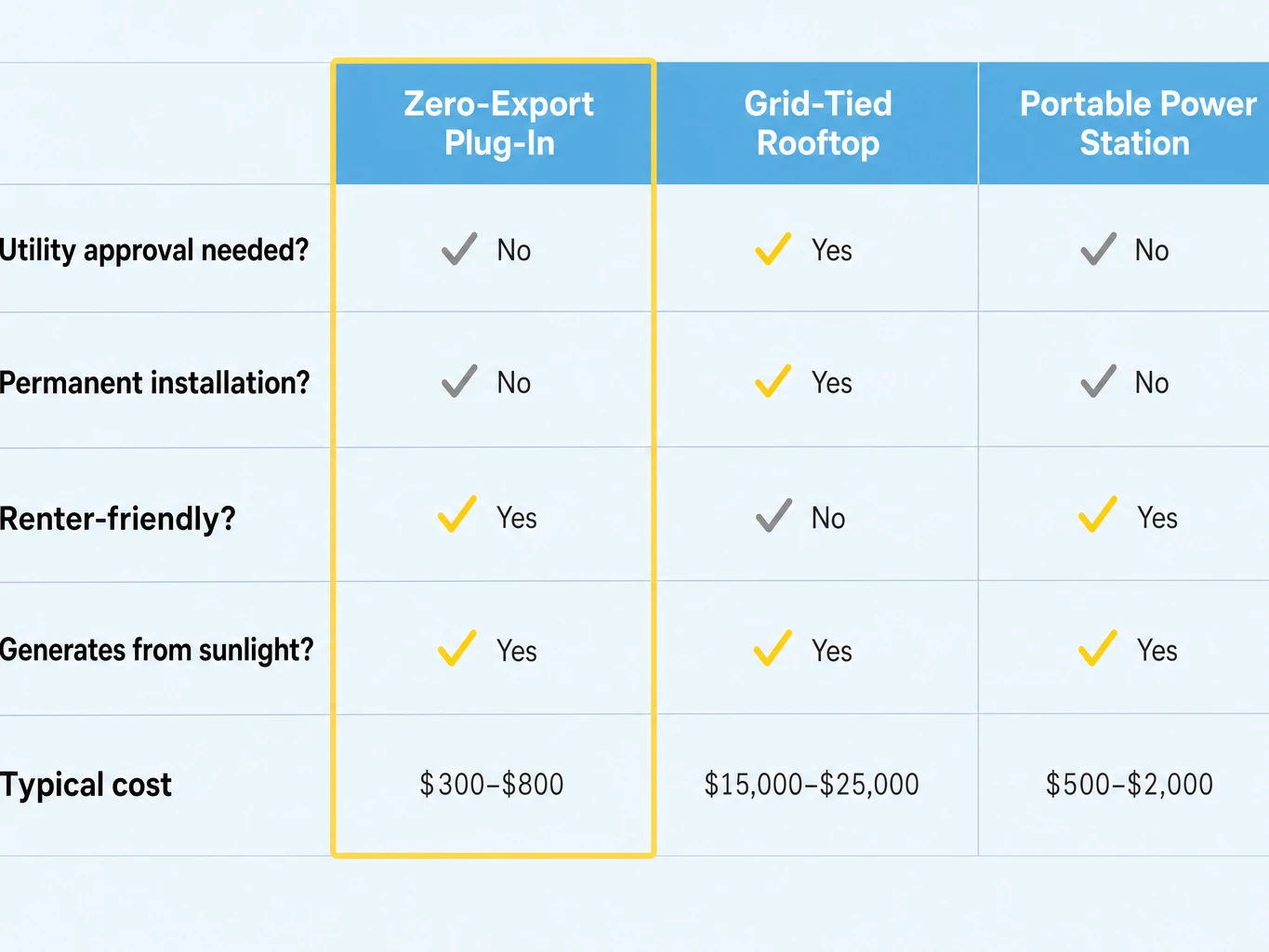
| Feature | Zero-Export Plug-In | Traditional Grid-Tie | Portable Power Station |
|---|---|---|---|
| Backfeed to grid | None (throttles down) | Yes, automatic export | No (battery only) |
| Utility approval needed | No | Yes (3–6 months) | No |
| Upfront cost | $600–1,200 | $8,000–15,000+ (rooftop) | $800–3,000 |
| Landlord approval | Easy (no backfeed risk) | Hard (seems risky) | Easy (portable) |
| Wasted solar energy | 10–25% annual curtailment | None (uses all production) | N/A (battery-limited) |
| Monthly savings (800W) | $16–30/month | $20–40/month | $0–10 (discharge dependent) |
| Best for | Renters, no utility hassle | Homeowners, max exports | Renters without roof access |
| Requires battery | No | No | Yes |
One scenario where portable power actually edges ahead: if you commute or work outside the home during peak sun hours (roughly 9am–3pm), a battery captures energy you'd otherwise curtail. Renters who are home during the day — or who run appliances on a daytime schedule — get the most from zero-export because their consumption is already high when the sun is brightest.
The Hidden Cost: Wasted Solar Energy
Here's what zero-export systems don't advertise: they waste solar energy during peak production hours.
When your home is using 200 watts but your 800W panel is producing 600 watts, the system throttles the microinverter down to 200 watts. Those 400 watts of potential production are curtailed: not used, not exported, not stored. Simply lost.
In a sunny, temperate climate, expect to lose 10–25% of your annual production to curtailment. In winter or cloudy regions, losses are lower. In Arizona or California with high daytime sunshine, losses can exceed 25% if you're away during peak hours.
This is the trade-off for zero-export's regulatory simplicity. You gain instant utility approval, but you sacrifice some energy harvest. For most renters, it's worth it. The approval bottleneck is the bigger obstacle.
The most direct way to recover those losses is to add a battery. A storage add-on (such as an EcoFlow PowerStream or a compatible home battery) captures the curtailed watts instead of discarding them. You draw that stored energy back later — at night, during a cloudy morning, or any time your home is consuming more than the panels are currently producing. For renters who are away from home during peak sun hours, a battery can meaningfully close the gap between zero-export and a full grid-tie system. The trade-off: expect to add $500–1,500 to your upfront cost, and a modest increase in setup complexity.
Zero-Export Plug-In Systems: What You Actually Need
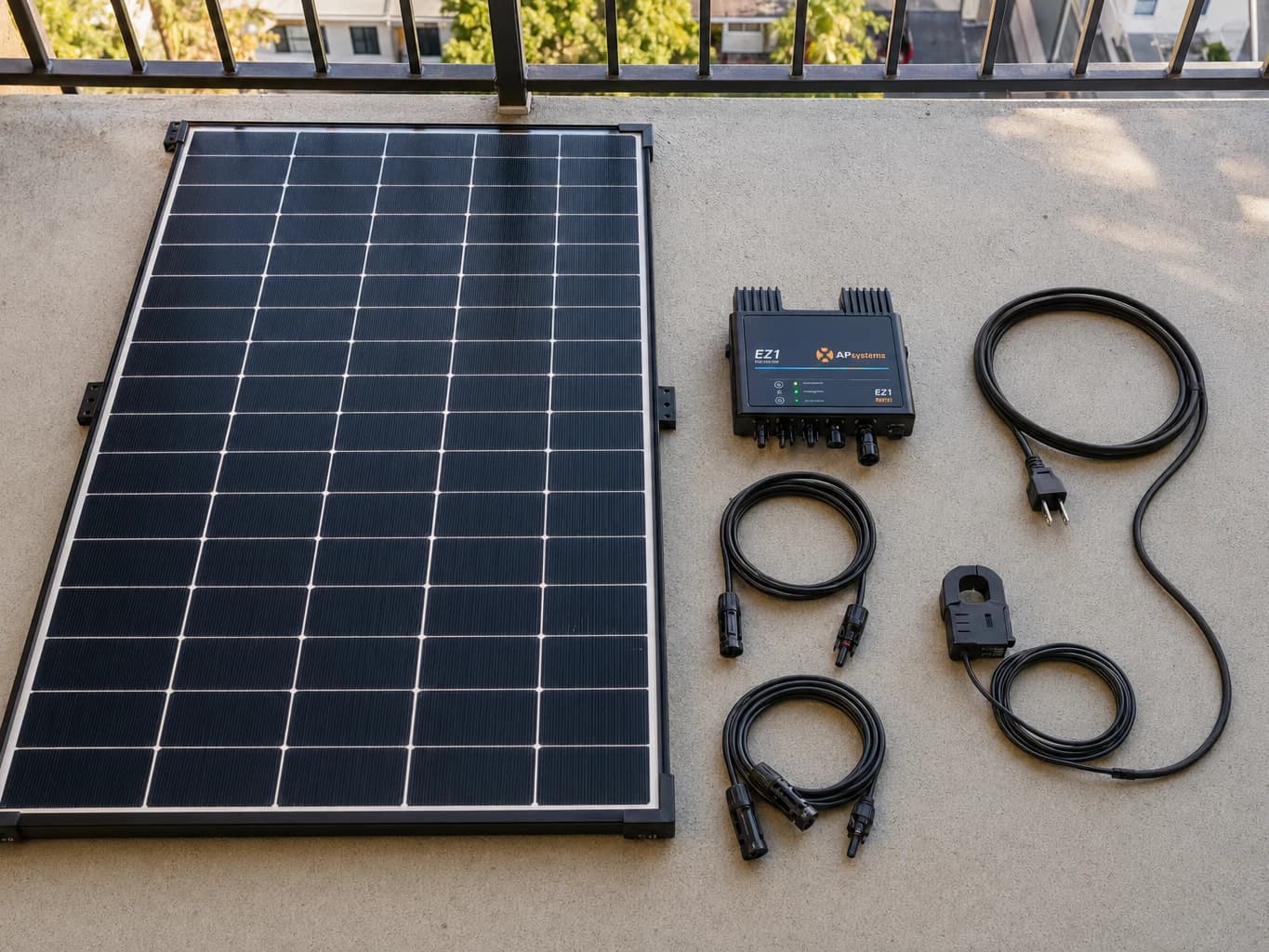
Zero-export plug-in systems typically come as plug-and-play solar kits: a solar panel (400W–1,600W), a zero-export inverter, mounting hardware, cables, and a plug. Here's how the sizes stack up:
~40–60 kWh/month · $8–15/month savings
Good for testing the concept, small apartments, or limited balcony space.
~80–120 kWh/month · $16–30/month savings
The sweet spot for most renters: fits a typical balcony, noticeable bill reduction.
~120–180 kWh/month · $24–45/month savings
Larger balconies, dual panels, battery storage, serious offset.
~160–240 kWh/month · $32–60/month savings
Ground mounts, multiple panels, expandable battery storage, maximum offset.
Savings vary by location and electricity rate. Use our calculator for your specific numbers.
Zero-export capability is increasingly standard in 2026. Craftstrom, EcoFlow, Pii Energy, and Bright Saver all include it as a core feature — sometimes built into the microinverter, sometimes as an optional external controller. Check the product specs for “zero-export” or “grid export limiting” explicitly before buying.
The Legislative Turn: Why Zero-Export Is Suddenly Legal
For years, plug-in solar existed in regulatory limbo. Utilities classified it as grid-tied solar, demanded interconnection approval, and renters were stuck.
But in 2025–2026, something shifted. State after state began writing bills specifically for plug-in solar, and zero-export design became the legal key that unlocked those bills.
The common pattern in every state bill: systems must be zero-export or export-limited.
- Utah — HB 340 passed in 2024, the first enacted law.
- Virginia — SB 250 takes effect January 2027.
- Maine — law takes effect July 2026.
- Maryland and Colorado — bills moving through committee now.
- Roughly half of the 50+ active bills tracked across 29 states include zero-export as the compliance mechanism.
This legislative momentum explains why zero-export is suddenly everywhere. It's not a technical trend — it's a regulatory solution that turned a workaround into a mainstream product category.
Checking Your State's Rules
Even with the legislative push, rules vary by state. Enacted laws in some states explicitly allow zero-export plug-in solar with no utility approval needed. Other states require basic notification (informational only, no approval process). And many states are still in the “tolerated but undefined” zone.
If you're in a state without explicit plug-in solar legislation, zero-export solar is still your best legal path. It removes the interconnection requirement by design. For systems under 1,200W, most utilities won't ask. The ones that do typically just want confirmation that your system can't backfeed.
Frequently Asked Questions
Common questions about zero-export solar for renters.
Ready to see how much zero-export solar could save you?
Enter your zip code and monthly electricity bill. Our calculator uses real solar data for your location to estimate your savings.
Last updated: April 25, 2026. Information on this page is reviewed quarterly for accuracy.