Do You Need a Permit or Utility Approval for Plug-in Solar?
Good news if you're about to plug in your first solar panel: in most situations, you don't need to pull a building permit or wait for your utility company to say yes. What you do need depends on your state and your system size. In 2026, that picture is changing fast — five states have now passed laws that explicitly remove the old approval requirements.
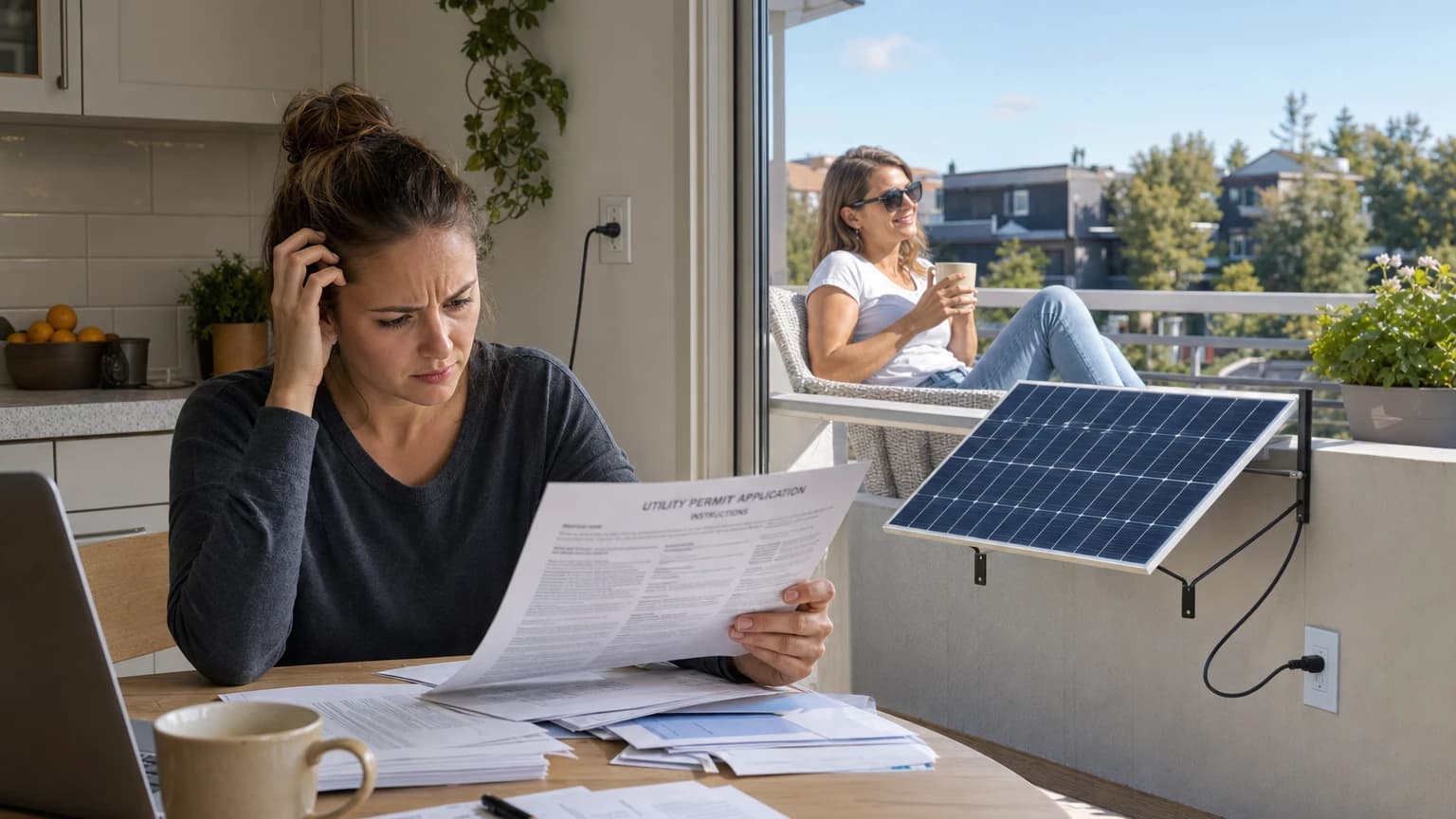
Do you need a building permit to install plug-in solar panels?
For a standard balcony solar or patio setup — panels plugged into an existing outdoor outlet with no wiring changes — you almost certainly don't need a building permit. Utility approval requirements depend on your state. Five states have passed laws explicitly removing them; everyone else is in a legal gray zone.
That's different from rooftop solar, which requires permits because it physically changes the building's electrical system and roof structure. Plug-in solar bypasses all of that by connecting through an outlet that already exists.
The one exception: if you're mounting panels on a rooftop instead of a balcony or ground level, some jurisdictions may still want a building department sign-off for the structural attachment. But for the vast majority of renters and apartment dwellers using balcony-mounted systems, there's no permit involved.
Does your utility need to approve your plug-in solar system?
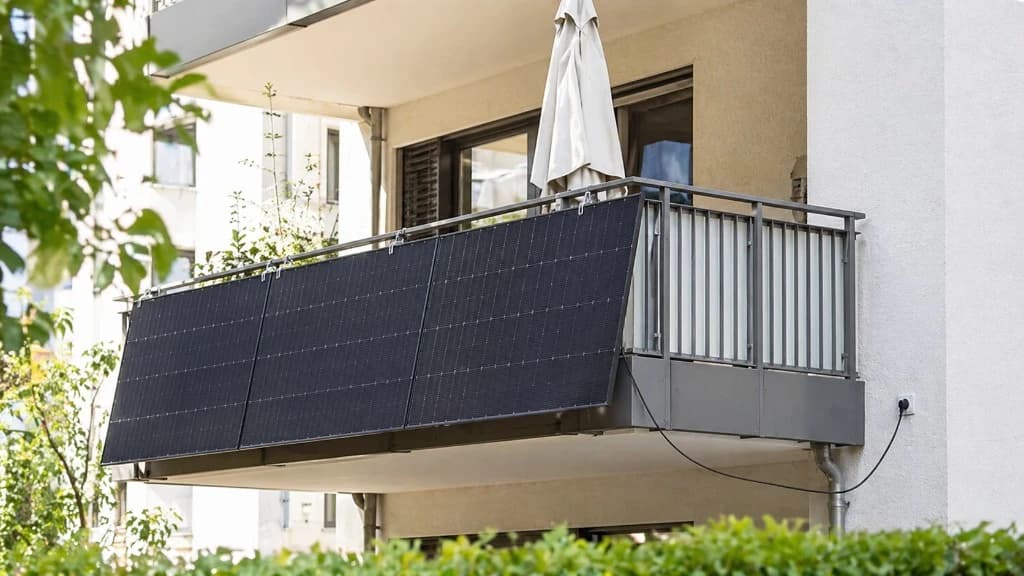
If your state has passed a plug-in solar law: no. Your utility cannot require approval before you install. If your state hasn't passed one yet, this is where it gets complicated.
A standard interconnection application for rooftop solar involves engineering reviews, fees that typically run $50–$1,000, and wait times measured in weeks or months. That process was built for systems producing 5 kilowatts or more. Nobody wrote those rules with a 600-watt balcony solar panel — typical of solar panels for renters — in mind, but no separate category existed, so utilities applied them anyway.
That's what the new state laws fix. By creating a distinct category for small plug-in systems, they prohibit utilities from requiring interconnection agreements, charging interconnection fees, or demanding approval before you plug in. The utility question disappears entirely.
The catch: as of April 2026, only five states have enacted these protections. For everyone else, the rules are murkier. Germany solved this problem years ago — see why Germany's balcony solar rules are so much simpler for the full story of why the US approval process looks so different.
Most enacted state laws sidestep the interconnection question entirely by requiring zero-export solar — a system that never sends power back to the grid has nothing for the utility to approve in the first place.
Which states have passed plug-in solar laws?
Here's where each state stands on plug-in solar regulation that removes utility interconnection requirements:
Some states have already passed plug-in solar laws that treat small, certified systems more like household appliances than full rooftop solar projects. In those states, the law removes the old utility approval process for qualifying systems.
Many other states are considering similar changes. The details vary, but the direction is consistent: lawmakers are creating a separate path for small plug-in systems that does not rely on traditional interconnection approval.
Laws are moving fast. Get notified when your state advances
We track each state's plug-in solar laws. We'll alert you the moment it clears the legislature.
Read the full law for your state
- Utah — read the full story of how Utah's law came to be
- Colorado — see the full Colorado law breakdown
- Virginia — Virginia's SB 250 / HB 395 details
- Maine — read the full LD 1730 breakdown
- New York — legislature passed, awaiting the Governor's signature
- Washington — pending 2027 legalization; read the story of HB 2296
What if your state hasn't passed a plug-in solar law yet?
You're in what advocates call the gray zone. Plug-in solar isn't banned. It isn't clearly legal either. The rules that exist were never written with your 800-watt balcony panel in mind.
Most utilities in gray-zone states don't actively monitor interconnection rules for small plug-in systems, particularly those using certified zero-export equipment. Zero-export means the microinverter only produces as much power as your home is drawing in that moment. Power never flows back toward the grid, which removes the utility's central concern: backfeed onto lines a technician assumes are de-energized. For a deeper look at what those certifications prevent, see our plug-in solar safety guide.
A handful of utilities have sent letters to customers running uncertified or DIY systems. The risk is real, even if enforcement is rare. If you want to be thorough, call your utility's interconnection or generation line and ask about their policy on plug-in solar generation under 1,200 watts.
In a gray-zone state, keep your system under 1,200W and use only a UL-listed, zero-export microinverter. Export-capable connections are exactly what utilities care about, and an uncertified system can't prove yours isn't one.
Our state legality guide tracks which states have active bills and what the current status is. Check there before you decide.
Want to see what a compliant system would save you in your state? Try our free savings calculator →
What's the difference between utility approval and utility notification?
These aren't the same thing, and the distinction matters.
Utility Approval
The utility reviews your application, evaluates your system, and has the power to say yes or no. This is what rooftop solar requires — and what plug-in solar laws eliminate.
Utility Notification
You tell the utility what you installed, usually within 30 days. The utility cannot deny your installation based on this notification. It's informational only — like registering a car after you've already bought it.
Maine requires notification for systems over 420W. Virginia requires notification period. Maryland requires notification plus device information. None of these utilities can block you from proceeding.
If your state requires notification, the process is typically a short online form or a phone call. The bigger question — whether your utility can stop you — has the same answer across all enacted laws: no.
What about HOA or landlord approval?
Two enacted laws directly address tenant rights for solar panels for renters. Virginia's law prohibits landlords with four or more rental units from banning plug-in solar. Colorado takes the same position: landlords can't prohibit installation, though they can set rules about fire safety and circuit overload.
Everywhere else, utility rules and building permits are separate from your lease agreement — and your lease still applies to any renter-friendly solar setup. Read yours before you install. Most leases are silent on solar panels, which generally means you're fine. A lease that prohibits exterior modifications or equipment attached to the building is more ambiguous.
Beyond utility rules, renters also need landlord permission in most states — see our full guide on how to ask your landlord for plug-in solar.
The Solar Rights Alliance maintains a state-by-state tracker and template letters for renter situations.
What do you actually need to do before plugging in?
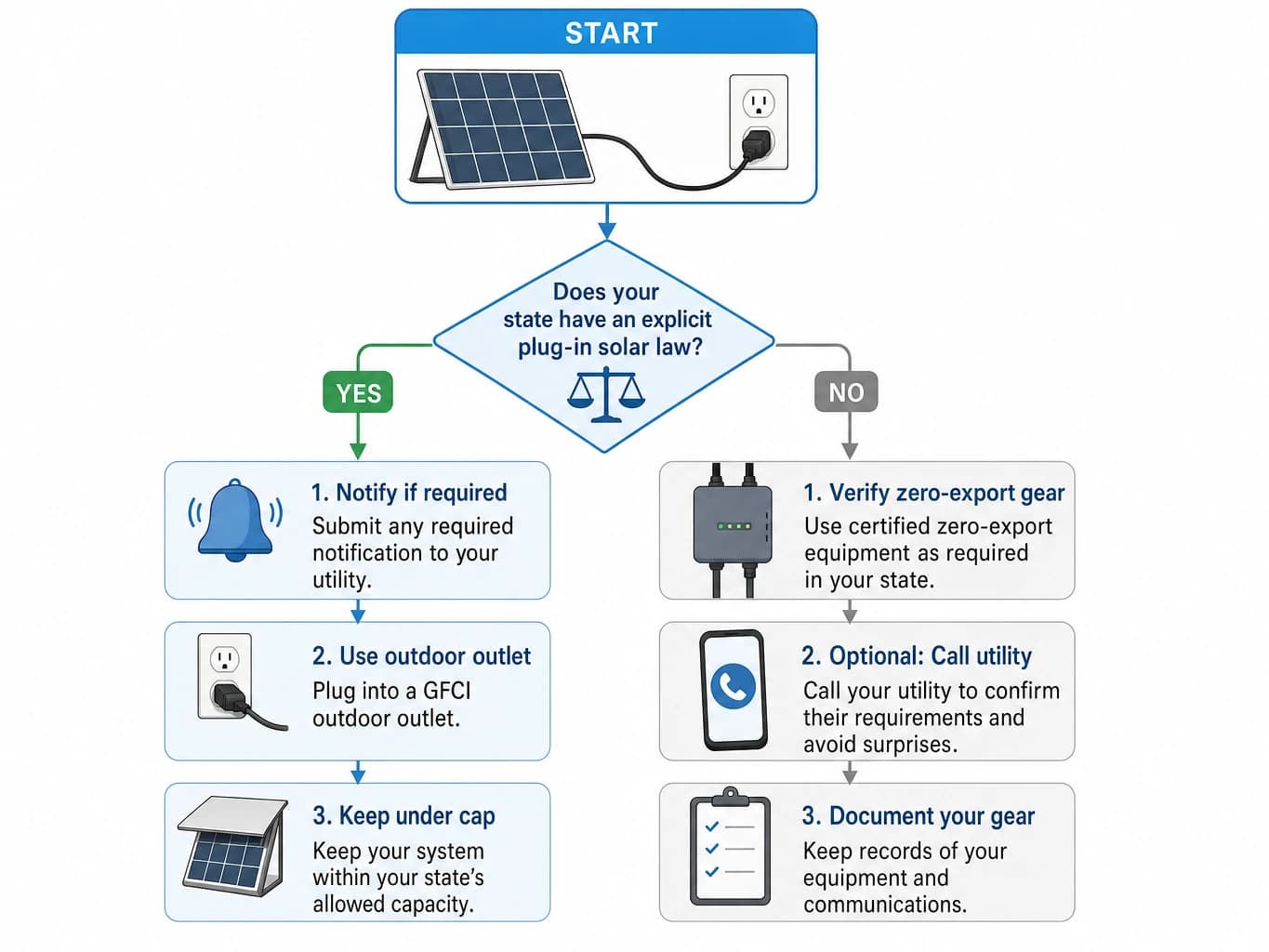
- 1
Check your state's status
Has your state enacted a plug-in solar law? Check our state guide to find out.
- 2
Verify your system size
Most enacted laws cap at 1,200W (Colorado at 1,920W). A standard 800W kit fits within every enacted state's limit.
- 3
Confirm UL certification
Every state law requires the system to be certified by UL or an equivalent nationally recognized testing lab. Check for the UL listing mark on your microinverter.
- 4
Check for notification requirements
Maine (>420W), Virginia, and Maryland require utility notification after installation. Look up your state's specific requirements.
- 5
Read your lease or HOA rules
Separate from utility rules. If your lease is ambiguous, ask your landlord in writing before you install.
- 6
Skip the building permit (almost certainly)
If you're plugging into an existing outlet with no structural or electrical panel changes, you don't need one.
- 7
No state law? Keep it small and certified
Stay under 1,200W, use only a UL-listed zero-export microinverter, and call your utility to document their response in writing.
For most people in an enacted-law state, there's no plug-in solar permit to pull and no utility approval to wait for. Buy a UL-certified system, mount it on your balcony, plug it in, and notify your utility if required. That's it.
Handling the install yourself? Start with our DIY installation guide for the full step-by-step process.
Frequently Asked Questions
Common questions about plug-in solar permits, utility approval, and notification requirements.
See how much plug-in solar could save you
Enter your zip code and monthly electricity bill. Our calculator uses real solar production data for your location to estimate your annual savings.
Last updated: April 24, 2026. We review this page monthly as state legislation moves quickly. For the most current status in your state, visit our state-by-state legality guide.