Is Plug-In Solar Safe? The Real Electrical Risks Explained
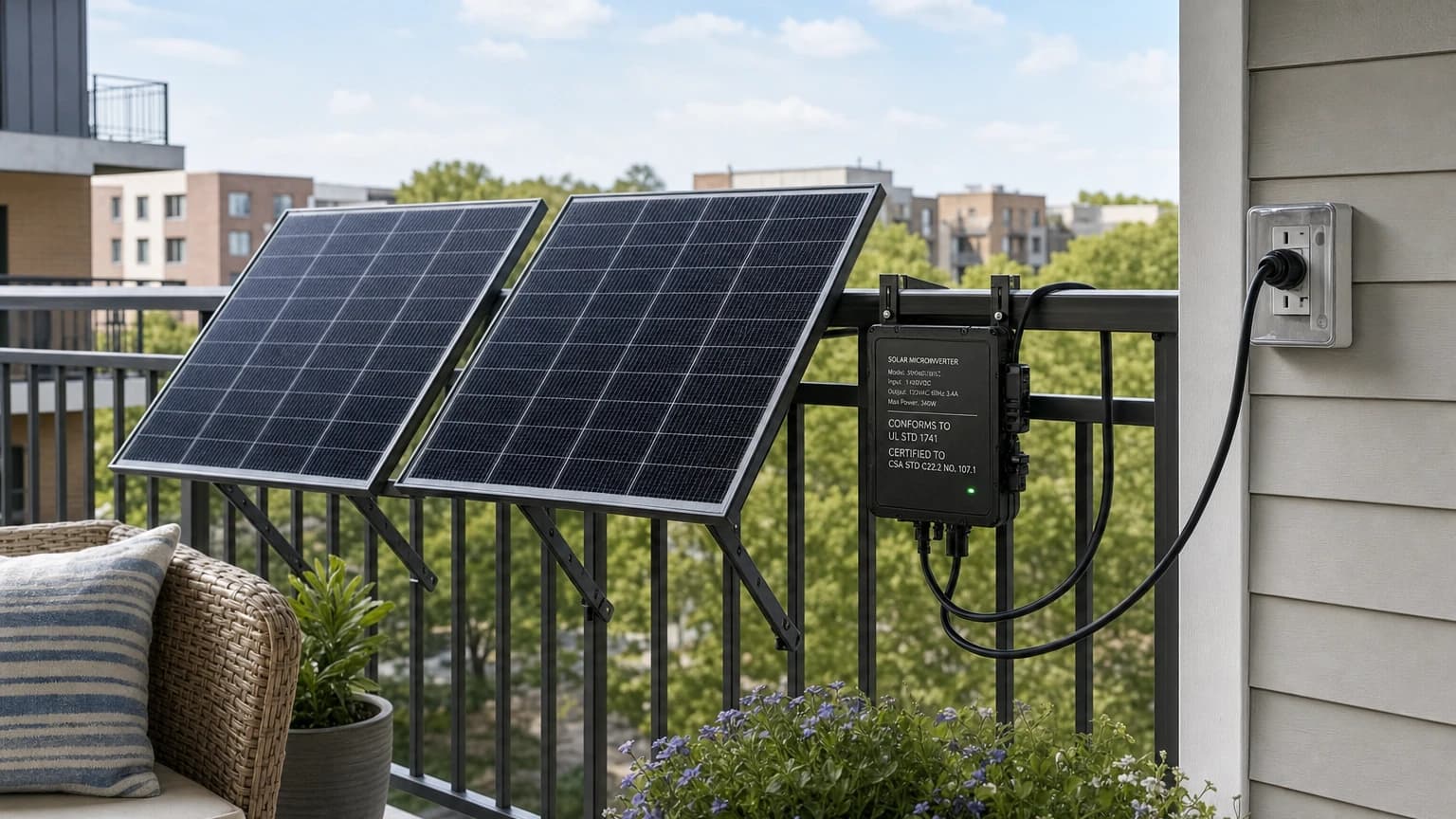
Plug-in solar is safe when the kit uses a certified microinverter built for US outlets and grid rules. The real safety question is not whether a panel makes electricity. It is whether the inverter can shut off during an outage, keep the plug dead when disconnected, and limit circuit load before wiring overheats.
Is Plug-In Solar Safe?
Plug-in solar is safe when the system's microinverter carries UL 1741 or UL 3700 certification. Certified inverters automatically shut off during power outages, de-energize the plug prongs within one second of disconnection, monitor circuit loads to prevent overheating, and detect ground faults. These protections are built into the hardware.
More than 4 million plug-in solar systems operate safely across Germany, the Netherlands, and Austria. The US is newer to this technology. Utah became the first state to legalize plug-in solar without utility approval in 2024, and nearly 30 states have since introduced similar legislation. UL Solutions formally launched the US certification standard (UL 3700) on January 8, 2026.
Not every state bill has cleared this cleanly. Washington's 2026 push nearly legalized plug-in solar before utility testimony about breaker masking convinced senators to strip the provision, a preview of the exact safety debate this article covers. Read the full story of Washington's HB 2296 fight for how that argument played out. Where a state has enacted a plug-in solar law, the permit and utility-approval picture changes too — see our guide to permits and utility approval for plug-in solar.
The divide between safe and unsafe plug-in solar has nothing to do with the concept. It's about certification and whether the inverter was designed for the way US home wiring actually works.
What's the Real Electrical Risk?
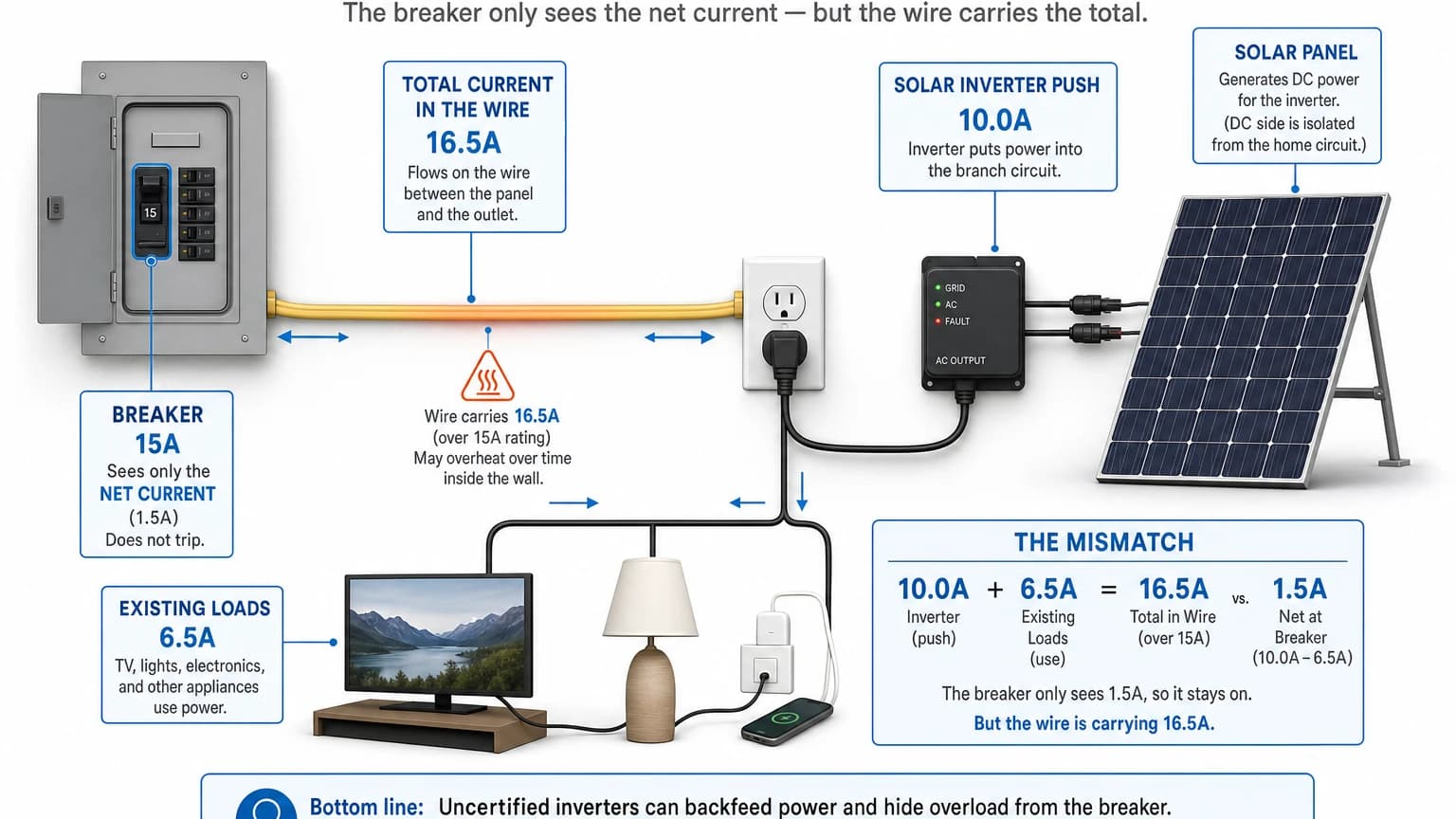
The specific hazard that makes uncertified plug-in solar dangerous has a name: breaker masking.
Here's the plain-English version. Your bedroom circuit handles a TV, a lamp, and a fan, together drawing 9 amps. A standard 15-amp US household circuit has 6 amps of headroom before the breaker trips.
Now plug in an uncertified solar inverter that pushes 8 amps back into that same circuit. Your devices still draw 9 amps, but now 8 of those amps come from the inverter instead of the utility. The breaker only measures net current flow. It sees 1 amp and stays closed.
Meanwhile, 17 amps are flowing through the wiring: 2 amps above its rated capacity. The breaker still looks calm, but the wire in the wall is now carrying more current than it was meant to handle. Over time the insulation can soften, the conductor can arc, and you end up with the kind of hidden electrical fault that starts a fire.
This is the real danger, not the panel sitting outside in the sun or the concept of generating electricity at home. It's a specific physics problem with a specific engineering fix: a certified microinverter that continuously monitors the circuit and caps its output so total current stays within safe limits. Apartments with older wiring face this risk most acutely — see our full guide to apartment-specific wiring concerns.
No UL certification. No overload monitoring.
That's the risk in one sentence. A cheap, uncertified inverter has no circuit awareness. It pushes whatever power the panel produces regardless of what else is on that circuit.
How Anti-Islanding Keeps Utility Workers Safe
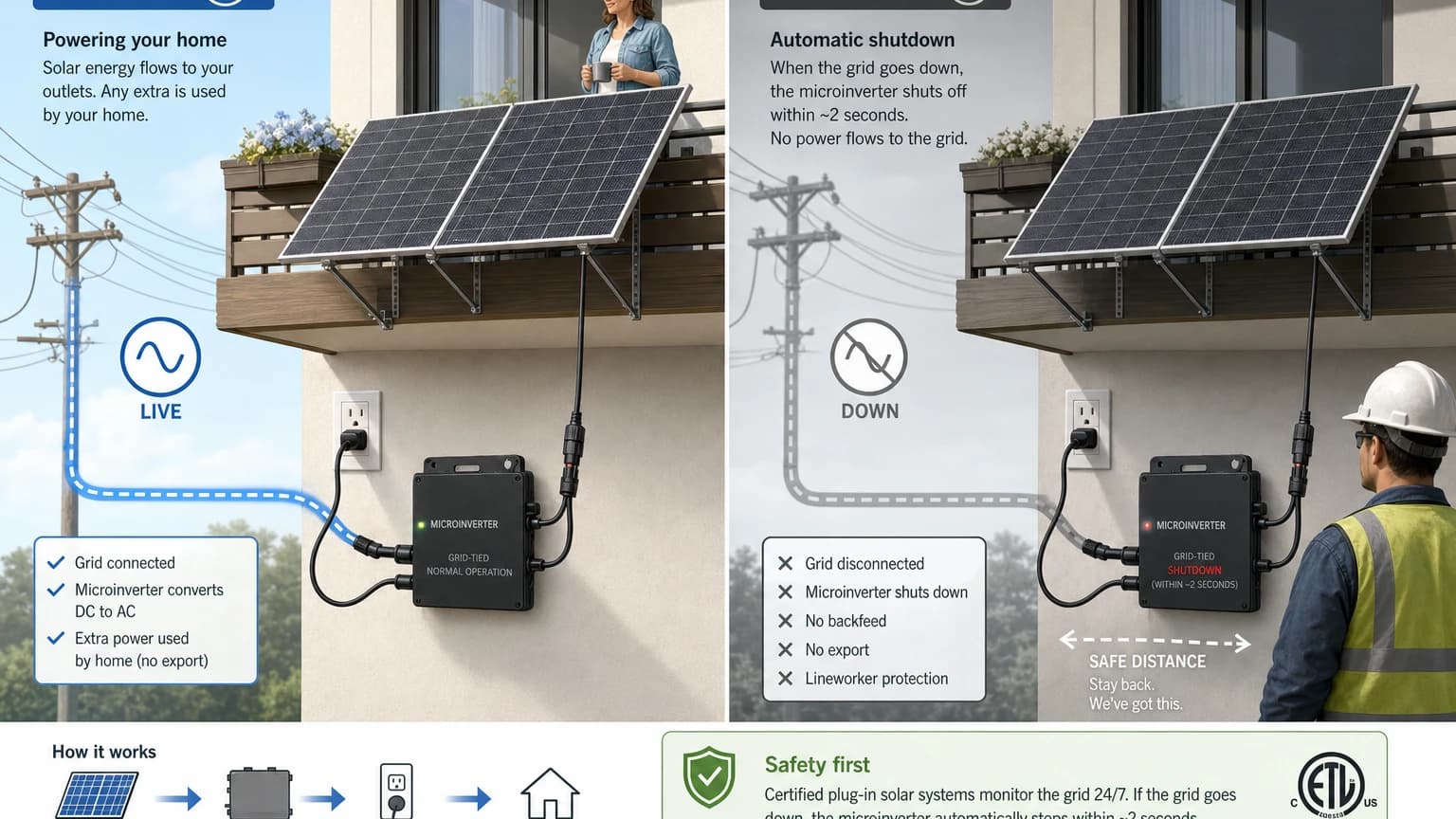
Anti-islanding protection addresses a different hazard, one that affects utility lineworkers, not just your walls.
When your neighborhood loses power, your solar panels are still generating electricity. An uncertified inverter might keep pushing that power into the grid, creating an "island" of energized lines that utility workers assume are dead. For someone with their hands on what should be a powerless wire, that's an electrocution hazard.
Certified plug-in solar microinverters monitor your grid's 60 Hz AC waveform continuously. The instant that signal disappears, usually within 1–2 seconds of a grid outage, the microinverter shuts off completely. Your panels stop sending power, and the lines go dead.
This is required under IEEE 1547-2018, the US standard governing all grid-connected inverters. No microinverter sold for legal US plug-in use passes certification without it. You can read more about exactly how this works in our guide to microinverters and grid synchronization.
Your plug-in solar system goes dark the moment the grid does, which is exactly the point.
That same shutoff means a grid-tied plug-in system provides zero power during an outage on its own — the whole design goal is to protect utility workers, not keep your lights on. If backup power during a blackout matters to you, you would need to add a battery to the setup rather than relying on the grid-tie inverter alone. Systems designed with zero-export solar take the same grid-loss protection a step further, since they never send power back onto the line in the first place.
What Does UL 3700 Certification Actually Require?
UL 3700, launched January 8, 2026 by UL Solutions, is the first safety standard built specifically for plug-in solar in the US. It requires five distinct protections, each addressing a specific failure mode.
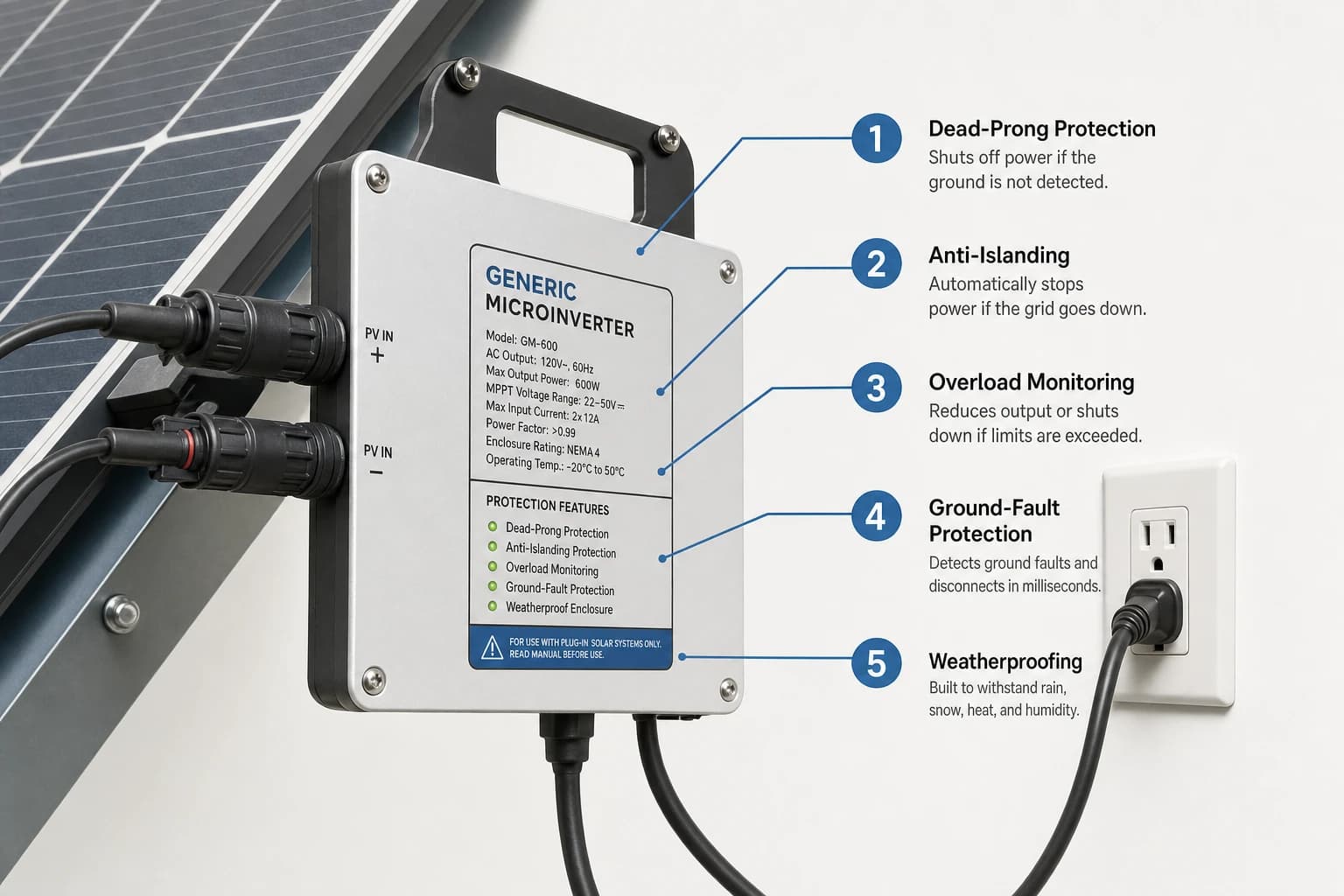
Dead-prong protection
The plug prongs must de-energize within one second of disconnection from the outlet. If you unplug the cord while the panel is in sunlight, the metal you touch is electrically dead before you can grab it.
Anti-islanding protection
The system must automatically shut off when the grid signal disappears, per IEEE 1547. No sending power onto lines that utility workers are handling.
Overload monitoring
The inverter must track circuit load and prevent total current from exceeding what the wiring can safely carry. No breaker masking.
Ground-fault protection
Built-in sensors detect unintended current leakage, meaning electricity flowing somewhere it should not, and shut the system down immediately.
Weatherproofing
Outdoor components must withstand sustained exposure to heat, cold, rain, and UV without degrading in ways that expose live electrical parts.
UL 3700 also requires the microinverter to separately meet UL 1741 as a prerequisite. Think of it as layers: UL 1741 is the baseline for all US plug-in inverters; UL 3700 adds the plug-specific protections on top.
As of early 2026, manufacturers were working through the UL 3700 certification process. APsystems' EZ1-LV microinverter was designed specifically for plug-in solar use. EcoFlow announced its STREAM microinverter for the US market and was actively pursuing UL 3700 listing.
Curious what a certified system would save you?
Enter your zip code to get an estimate based on local sun hours and electricity rates.
Try our free savings calculator →Can the Plug Shock You?
This is the question that makes people uneasy: if your solar panels are producing electricity, are the plug's metal prongs live?
With a certified system: no. With an uncertified one: possibly.
Dead-prong protection handles this directly. A UL 3700-certified inverter constantly checks whether it's connected to an active outlet. The moment you unplug the cord, or the power goes out, the inverter cuts output to the prongs within one second. What you're touching is dead metal, not live current.
This is categorically different from what's sometimes called a "suicide cable," a DIY connector with male plugs on both ends, used to backfeed power from a portable generator into household circuits. A suicide cord has no safety logic. If the generator is running when someone grabs the free end, the prongs are live at 120V. It's dangerous, it's illegal for generator use in the US, and it has nothing to do with certified plug-in solar systems.
The confusion exists because both involve a male plug connected to a power source. But a certified plug-in solar inverter is an intelligent device with multiple monitoring systems, not a passive cable. For a full breakdown of how this works, see our explanation of how plug-in solar connects to a standard outlet.
Which Safety Risks Matter Most?
Not every risk deserves equal weight. Breaker masking is the one that can quietly overheat wiring inside your walls, so it deserves the most attention. The other two are still important, but they're easier to explain quickly once you understand the main failure mode.
Fire risk from overload is the big one
In an uncertified setup, the inverter can keep feeding current onto a circuit even when the room is already using most of that circuit's capacity. The breaker sees less net current than the wire is actually carrying, so it never trips when it should.
UL 3700 addresses that with overload monitoring. A compliant inverter tracks the circuit load in real time and limits its own output before the wiring crosses a safe threshold.
Shock risk at the plug
Without dead-prong protection, unplugged metal prongs can stay energized. A certified inverter cuts output within one second, so the plug is electrically dead by the time you can touch it.
Grid backfeed during an outage
Without anti-islanding, an inverter could keep pushing power onto utility lines during a blackout. IEEE 1547-compliant shutdown logic cuts the system off within 1–2 seconds instead.
How Do You Know If Plug-In Solar Is Safe to Buy?
The inverter's certification is the one thing you can't skip. Everything else is secondary. Here's what to verify before purchasing any plug-in solar system.
| Check | What to Look For | Red Flag |
|---|---|---|
| Inverter certification | UL 1741 or UL 3700 marking on the unit | No UL mark, CE-only (Europe), or no mention of certification |
| Anti-islanding | "IEEE 1547 compliant" in the spec sheet | Spec sheet is vague or missing |
| Plug type | NEMA 5-15 (standard US 3-prong) at 120V | Schuko / Type F plug (European 230V) |
| Installation docs | English-language instructions with circuit guidance | No instructions, or foreign-language only |
| Price sanity check | Microinverters $150–$400; kits $400–$1,500 | Sub-$80 inverters from unknown brands |
European plug-in solar products deserve a specific warning. Germany has installed over 4 million balcony solar (also called plug-in solar) systems, and that success has produced a lot of high-quality equipment. But it all runs on 230V with Schuko connectors, not the 120V NEMA outlets found in US homes. A German-specification inverter won't work safely in a US outlet regardless of any adapter. If a product lists a Schuko plug or 220–240V input, it's not built for this country.
Once you've verified the inverter certification, the rest of buying a plug-and-play solar kit is straightforward. Use a dedicated outdoor outlet, not an extension cord daisy-chain. Follow the manufacturer's instructions on circuit load limits. In most states with enabling legislation, that's everything the installation requires. For the actual step-by-step process and when you might still want an electrician, see our DIY installation guide. If you're renting and expect pushback on safety grounds, our guide to asking your landlord for permission walks through exactly how to address those concerns.
Once a system checks every box on this list, the last question is usually financial: how long until it pays for itself? Our plug-in solar payback period breakdown walks through real numbers by state and system size.
Frequently Asked Questions
Common questions about plug-in solar safety.
Want to understand more about how plug-in solar connects to your home's electrical system? Our full guide to how plug-in solar works covers the complete picture, from the panel to your electricity meter.
Ready to find a certified plug-in solar system?
Every product in our catalog has been reviewed for certification status and US compatibility. Or run our savings calculator to see what a system would save you before you buy.
We may earn a commission when you purchase through these links — it doesn't affect the price you pay. See our full disclosure →
Last updated: April 22, 2026. Information on this page is reviewed monthly for accuracy.