Can I Install Plug-in Solar Myself or Do I Need an Electrician?
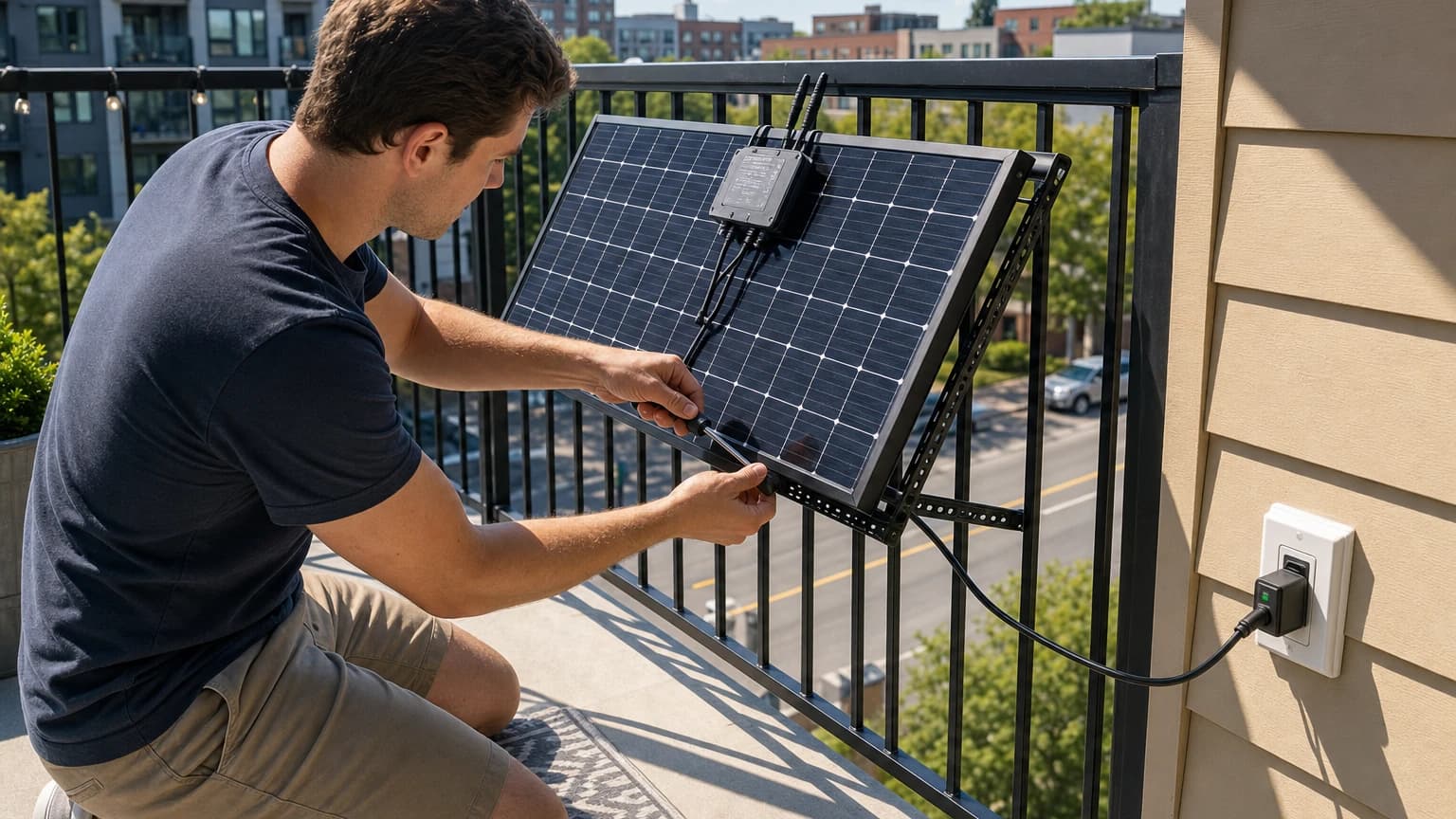
Most people can handle plug-in solar DIY installation themselves, start to finish, in about 90 minutes with a standard screwdriver. You mount the panel on your balcony or patio, snap the microinverter onto the panel frame, run the AC cable indoors to your outlet, and plug it in. No electrical license. No building permit for the solar system itself. The main exception—running a new outdoor circuit when one does not exist—adds real cost and changes the decision. Keep reading to see if that applies to your setup.
Do Most People Need an Electrician to Install Plug-in Solar?
For the majority of plug-in solar buyers: no electrician required. A 400W or 800W kit goes up in an afternoon. You need a screwdriver and the mounting hardware that comes in the box. No electrical license, no building permit for the solar system itself, no specialized training.
The reason this matters for renters and apartment dwellers is cost. A professional rooftop installation runs $8,000–$12,000+. A plug-in system you install yourself tops out at $1,500 for most households. That gap is why the market exists, and why DIY accessibility is the whole point.
The one scenario that changes this: if you do not have an existing outdoor outlet, running a new circuit from your breaker panel requires a licensed electrician. That work adds $300–$600 and affects your payback timeline. The sections below walk through each scenario so you know exactly where you stand.
What Does a Plug-in Solar DIY Installation Actually Look Like?
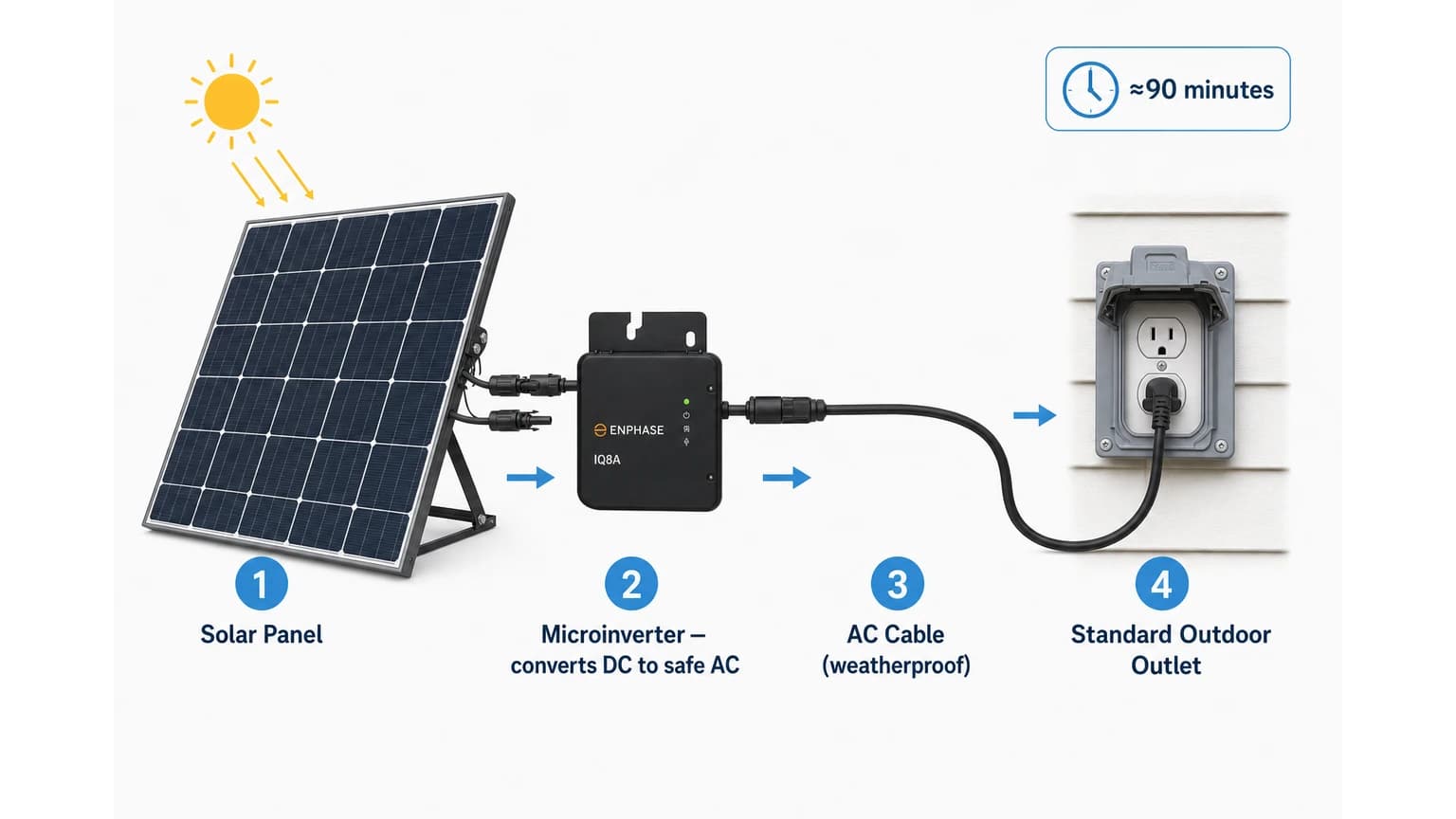
A typical plug-in solar DIY setup takes four steps: mount the panel on your balcony railing, patio, or ground stand using the included hardware; snap the microinverter onto the panel frame; run the AC cable from the microinverter to your indoor outlet; plug it in.
Take the microinverter. It snaps onto the panel frame using a simple bracket, weighs under 5 pounds, and uses a standard weatherproof connector to link with the panel. No hardwiring. No tools beyond a screwdriver. Most manufacturers include a QR code linking to a 5-minute video walkthrough, and balcony rail clamps ship pre-assembled. Learn how microinverters actually work →
Typical installation timeline
- 5 minUnpack and inspect parts
- 20 minMount the panel using the rail clamp or ground stand
- 10 minSnap the microinverter onto the panel frame
- 15 minRun the AC cable from the panel to your outlet, clipping it under window trim or along the baseboard
- 5 minPlug in and verify the monitoring app shows power flowing
Want detailed step-by-step instructions? View our complete installation guides →
The only real skill you need: basic comfort with a screwdriver. The DC voltage from the panels (30V+) is isolated inside the microinverter, where it gets converted to safe 120V AC before reaching your outlet. When the system is plugged in, a certified microinverter cuts power within 1–2 seconds if the grid goes down. That is what makes plug-in solar DIY installation safe for non-electricians. The safety engineering is built in.
Not sure your balcony wiring can handle it? Our wiring safety guide explains what to look for in older buildings.
Ready to see detailed installation steps?
Choose your installation scenario for step-by-step visual guides:
When Does Plug-in Solar Require a Licensed Electrician?
Not everyone has an existing outdoor outlet. If that is you, here is what changes.
Scenario 1 — No outdoor outlet exists
Running a new circuit from your breaker panel through an exterior wall to install a weatherproof outlet requires a licensed electrician in all 50 states. The work involves opening your breaker panel (serious shock risk), running conduit through walls, and ensuring everything meets the National Electrical Code (NEC).
Cost: $300–$600 based on typical 2025–2026 contractor rates. Timeline: 2–4 hours for the electrician, plus permit processing time if your area requires it.
This changes your plug-in solar economics significantly. A $600–$1,200 DIY kit becomes $900–$1,800 with the electrician cost. Your payback period stretches from 4–5 years to 6–8 years, depending on your state's electricity rates.
Scenario 2 — Your state mandates an electrician for your system size
Maine's plug-in solar law (effective July 1, 2026) requires a licensed electrician for systems exceeding 420 watts. If you want an 800W system in Maine, you must hire someone. Other states (Utah, Virginia, Maryland, Colorado) passed plug-in solar laws in 2025–2026 without electrician mandates. But as more states legalize, some will follow Maine's approach.
Scenario 3 — Your electrical panel is old or full
Older homes with 60-amp service or outdated panels might need an electrician to assess whether adding a new circuit is safe. This is not usually necessary for plug-in solar (which draws only 3–7 amps for typical 400–800W systems), but if your panel is full or deteriorating, have an electrician inspect it first.
Scenario 4 — You would rather pay for peace of mind
Even when the outlet exists and the install is straightforward, some people prefer professional help. That is a reasonable call. But understand what you are hiring for: the electrician does not make the system itself safer. The microinverter certification does that. You are paying for comfort, not a code requirement. The outlet installation requires a licensed professional; the solar system itself does not.
Pre-Installation Electrical Assessment: 5 Steps Before You Start
Before you order any system, verify you have a suitable outlet. This takes 15 minutes and tells you exactly whether you can DIY or need professional help.
Find your existing outdoor outlets
Walk around your apartment or house. Check balconies, patios, side yards, and basement stairs. Look for weatherproof-rated outlets (usually marked with a "W" or raindrop symbol). Many homes have at least one. If you find one, you are good to go with no electrician needed.
Check the outlet type
Modern outdoor outlets should be GFCI-protected (Ground Fault Circuit Interrupter)—the outlet with the small button you can press to test it. If your outdoor outlet is not GFCI-protected, ask an electrician to upgrade it (usually $100–$200). The GFCI outlet is the last safety layer between your outlet and a fault condition.
Assess the outlet's location
Can you safely run a cable from the outlet to where you want the panel? A 25–50-foot cable run is normal. Route the cable under door trim or along baseboards. Avoid high-traffic paths where people might trip. Avoid leaving cables exposed to sunlight for years (UV degrades the insulation).
Test the outlet for live current
Grab a cheap plug tester ($5–$10 from any hardware store) to confirm the outlet is live and grounded. You want to verify power is actually flowing before you mount expensive equipment depending on it.
Document the outlet specs
Note the outlet location, amperage rating (usually 15A or 20A), and whether it is GFCI-protected. This helps your electrician if you later decide you need a new circuit, and it helps your insurance company if you ever need to file a claim.
The Real Cost Difference: DIY vs. Electrician-Installed
The $300–$600 electrician cost is the pivot point that changes everything. A system that breaks even in 4–5 years when you have an outlet becomes a 6–8 year project when you need new wiring.
One strategic choice often avoids the cost entirely: if adding a new outlet is required, choose a smaller system size (400W instead of 800W) that fits an existing outlet. A 400W system costs less upfront, has no electrician cost, saves $10–$15/month instead of $20–$30, but pays back in 3–4 years instead of 5–8. You skip $400 in labor costs and start saving sooner.
The payback math depends on your electricity rate and how much sun your location gets. Try our free savings calculator to see your actual numbers before deciding on system size.
Here is how the full cost picture breaks down across three scenarios. The monthly savings below assume roughly $20/month in average US conditions—your number will vary by state electricity rate and local sun hours.
Visualizing the Cost Difference by Scenario
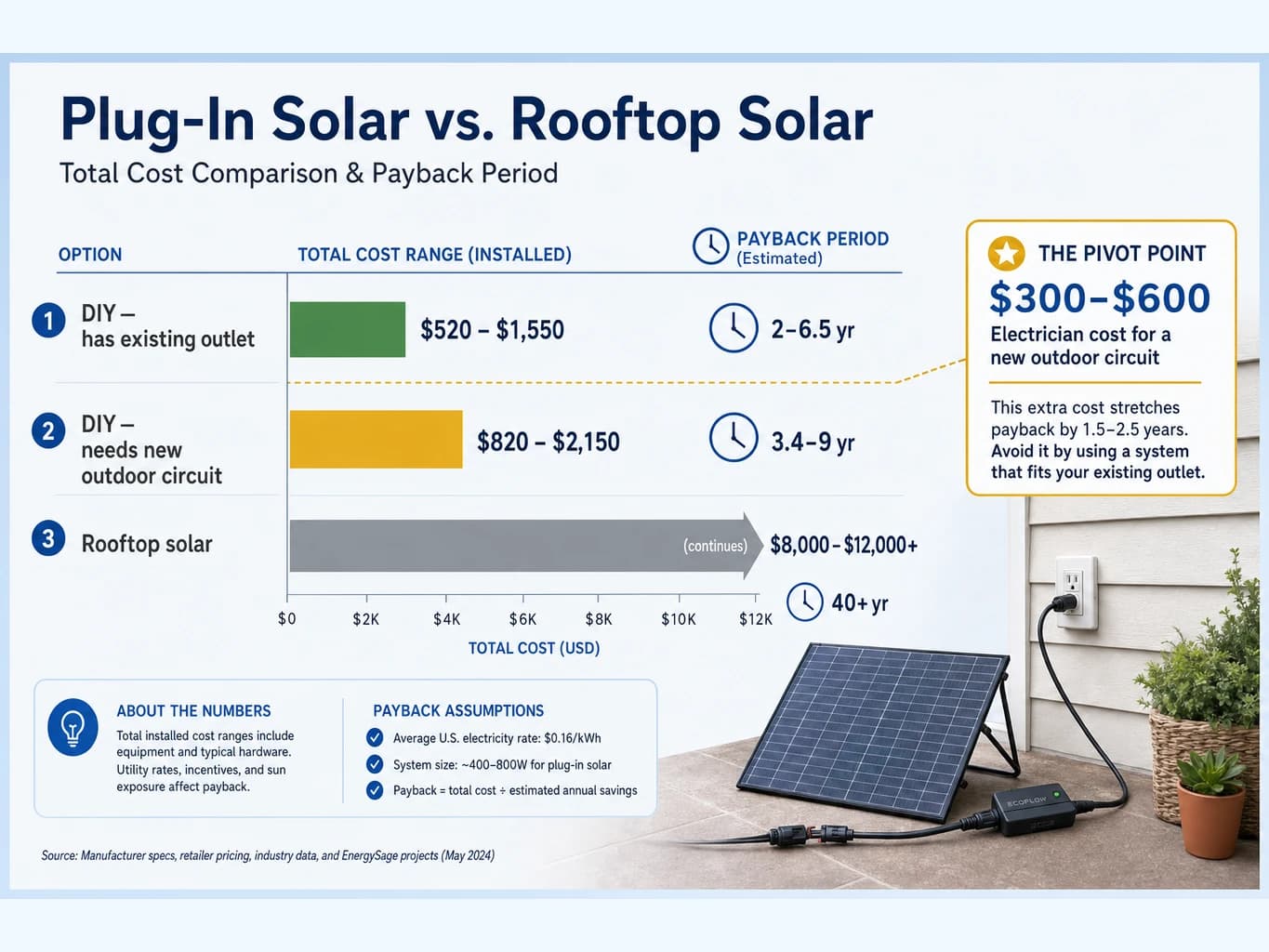
The chart above shows cost ranges across three common buyer situations. Key takeaway: the gap between "has an outlet" and "needs new wiring" can cost more than a second panel kit. Sizing down to fit an existing outlet is often the smarter financial move, especially for renters who may move within a few years.
After payback, the system generates pure savings. A 20-year panel lifespan and 12–25-year microinverter warranty mean you are looking at many years of free electricity after the break-even point. The rooftop solar comparison in the table below illustrates just how different the economics are.
If You Decide to Hire an Electrician: What to Expect
The electrician's role is limited to installing the outdoor outlet if you need a new one. Everything else is still your job: mounting the panel, snapping on the microinverter, running the cable from the outlet to the panel location.
Call a licensed electrician and say "I want a new weatherproof outlet on the [side/back] of my house." They will quote you $300–$600 all-in. They will run conduit from your breaker panel through the exterior wall, install a GFCI-protected outlet box, get it inspected if your area requires it, and test it.
Questions to ask before they start
- →"Is this outlet GFCI-protected?" (It should be.)
- →"What is the amperage of the breaker feeding this outlet?" (Should be 15A or 20A.)
- →"Will you pull a permit?" (Depends on your city; ask about the timeline.)
- →"Where should the outlet go?" (Point out exactly where you plan to mount the panel so the cable run makes sense.)
Most electricians charge $75–$150/hour plus materials. For a single new outlet, expect an invoice in the $400–$700 range. Get a written quote before work starts. See our full permit and utility approval guide →
Full Cost Comparison: DIY vs. Electrician vs. Rooftop
| Scenario | System Cost | Electrician Cost | Total Cost | Payback at $20/mo savings |
|---|---|---|---|---|
| DIY with existing outlet | $500–$1,500 | $0 | $520–$1,550 | 2–6.5 years |
| DIY + new outdoor circuit | $500–$1,500 | $300–$600 | $820–$2,150 | 3.4–9 years |
| Rooftop solar (professional) | $8,000–$12,000+ | Included | $8,000–$12,000+ | 40–60 years |
Once you know your numbers, browse the kits that fit your system size and outlet situation. Browse certified starter kits →
Safety Essentials: What You Need to Know (And What You Need to Wear)
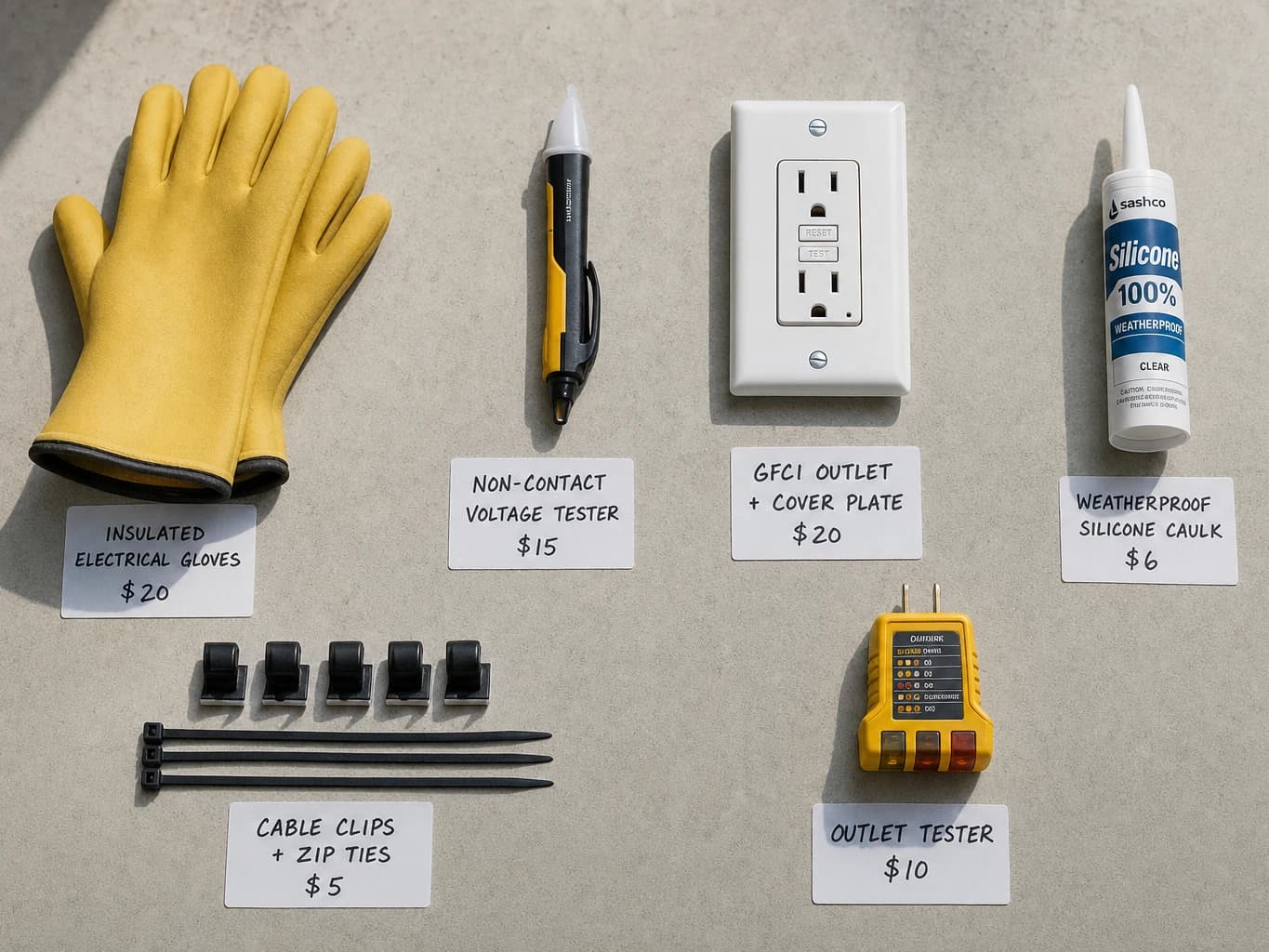
Electricity starts flowing the moment sunlight hits the panel cells, even on cloudy days. That 30V+ of DC voltage can deliver a serious shock if you touch exposed wires. Two systems do most of the safety work for you.
The microinverter handles 95% of it
It isolates the high-voltage DC from the low-voltage AC you touch. It includes anti-islanding protection that shuts down power within 1–2 seconds if the grid goes down, preventing backfeed into utility lines (which could electrocute lineworkers). That is a UL 1741 certification requirement, built into every certified system available today. Full breakdown of the electrical risks →
What you need to do on your end
- •Wear insulated gloves rated for electrical work ($10–$20)
- •Use insulated footwear (sneakers are fine; wet metal is not)
- •Do not install during rain or storms— water and electricity are a dangerous combination
- •Never touch the DC terminals on the back of the panel—they are live in sunlight
- •Test the anti-islanding protection after installation via your monitoring app
Certification is not optional
The single biggest safety difference between "safe to DIY" and "you might start a fire" is certification. The systems Simple Plug-in Solar recommends carry UL 1741 certification (the current US standard). Never buy uncertified gear from Amazon or international sellers without checking. Learn what UL 3700 actually requires →
State-by-State Installation Requirements: Your 2026 Guide
Plug-in solar is in a shifting legal moment. Some states explicitly allow it; others have not legislated it yet. Check your state's current status before buying.
| State | Law Status | DIY Allowed? | System Limit | Electrician Required? | Utility Notification? |
|---|---|---|---|---|---|
| Utah | Legalized (HB 340, 2025) | Yes | 1,200W | No | No |
| Maine | Legalized (LD 1730, 4/2026) | ≤420W yes; >420W no | 1,200W | >420W only | Yes, within 30 days |
| Virginia | Legalized (SB 250, 4/2026) | Yes | 1,200W | No | TBD |
| Maryland | Passed (4/2026) | Expected yes | ~1,200W | Expected no | TBD |
| Colorado | Passed (4/2026) | Expected yes | TBD | Expected no | TBD |
| Other 45 states | No legislation | Legal gray zone | No cap | Typically no | No requirement |
What "legal gray zone" means: In states without laws, plug-in solar is not explicitly banned, but it is not explicitly allowed either. Your utility might object. Your HOA might say no. Your landlord might prohibit it. The legal risk is low, but it exists.
Maine's >420W rule is the edge case. If you want an 800W system in Maine, you legally must hire a licensed electrician. Other states have not followed this pattern yet, but they might.
UL 3700 certification arrived in 2026. The APsystems EZ1 became the first UL 3700-certified microinverter in July 2026, and more brands are expected to follow. UL 1741 certification remains sufficient in the meantime. Do not wait for UL 3700 unless your state explicitly mandates it.
New York isn't in the table above yet. Its SUNNY Act passed both chambers in May 2026 and is awaiting the governor's signature — see our New York plug-in solar law page for the current status and expected DIY installation rules once it takes effect.
What Are the Most Common DIY Installation Mistakes?
Most installations go smoothly. Here are the stumbles people hit—and how to avoid them. For detailed step-by-step instructions, see our complete installation guides.
Choosing the wrong outlet type
Some older homes have ungrounded outlets or non-weatherproof outlets. You need an outdoor-rated, GFCI-protected outlet. If you are unsure, have an electrician verify before you buy equipment.
Overloading a shared circuit
A typical plug-in solar system draws 3–7 amps. Most circuits handle 15 amps. But if you plug the solar system into the same circuit as a microwave or window AC (both pull 10–15 amps), you might trip the breaker. Use a dedicated outlet with nothing else plugged in.
Installing in bad weather
Rain, wind gusts, and snow make installation harder and riskier. You are exposed on a balcony or roof, handling equipment. Wait for a calm, dry day. The system can wait a week.
Forgetting anti-islanding testing
After installation, verify that your monitoring app shows power flowing and that the system responds to grid outages. Most apps send a test shutdown signal that proves the anti-islanding circuit is live. Do this on day one.
Not documenting your system
Take photos of the installation, the outlet, the microinverter serial number, and the breaker feeding that outlet. Save your receipt and warranty information. If your house ever has an insurance claim, documentation proves proper installation.
Frequently Asked Questions
Common questions about plug-in solar DIY installation.
Ready to see what plug-in solar could save you?
Enter your zip code and monthly electricity bill. Our calculator uses real solar data for your location to estimate your savings and payback timeline.
Last updated: May 17, 2026. Installation guidance on this page is reviewed quarterly for accuracy and updated as new state legislation passes.