What Is UL 3700? The Plug-In Solar Safety Standard Explained
On January 8, 2026, UL Solutions launched UL 3700, the first US safety standard designed specifically for plug-in solar systems. Before that date, plug-in solar occupied a regulatory gap: products were selling, people were installing them, and the market was growing, but no single US certification covered the unique hazards of a plug-in solar system that connects through a standard household outlet. That gap started closing in July 2026, when the first UL 3700-certified microinverter reached the market. Here's what's certified, what's still on the way, and how to shop with confidence right now.
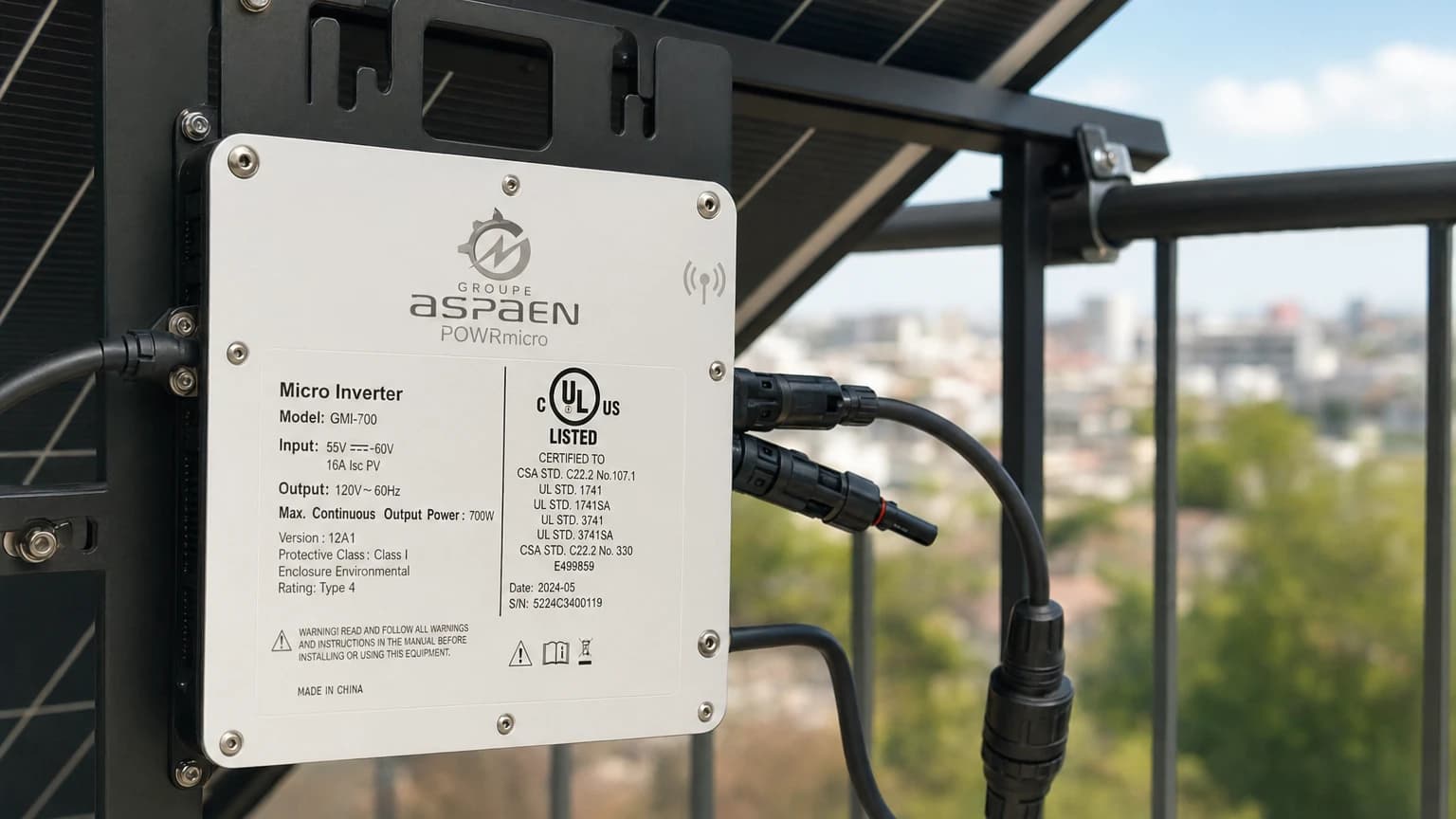
What Is UL 3700 Certification for Plug-In Solar?
UL 3700 is the US safety certification for plug-in solar equipment and systems, the panels, microinverters, cables, and plugs that connect to a standard household outlet. A UL 3700-certified product has been independently tested for dead-prong protection, anti-islanding, overcurrent protection, GFCI compatibility, and weatherproofing.
UL 3700-certified hardware you can buy today
APsystems says its EZ1 Plug-in Microinverter is CSA Certified to UL 3700, the first plug-in solar product to carry the mark. It costs $325 as of August 2026, takes up to 800W of panel input, and outputs up to 900W.
Pair it with the APmeter ($90 as of August 2026) if your setup needs zero-export control. Hoymiles announced its own UL 3700-compliant HiFlow Pro microinverter on July 15, 2026, though it hasn't published US pricing or a ship date yet.
We may earn a commission when you purchase through these links — it doesn't affect the price you pay. See our full disclosure →
The full designation is the Outline of Investigation for Interactive Plug-In Photovoltaic Equipment and Systems — UL 3700 covers both a single certified microinverter and a complete kit tested as one unit. UL Solutions published the standard in December 2025 and launched the certification program on January 8, 2026.
To understand how plug-in solar connects to your home's electrical system, our full explainer covers the mechanics. The safety picture only makes complete sense once you know what the system actually does.
Why Did Plug-In Solar Need Its Own Safety Standard?
Before UL 3700, the closest thing to a plug-in solar safety standard was UL 1741, the certification for grid-connected inverters, written for professionally installed rooftop systems hardwired into a dedicated circuit by a licensed electrician. It's a solid standard. It just wasn't designed for balcony solar panels that a renter or apartment dweller plugs into a GFCI outlet on their apartment balcony.
Plug-in solar brought three safety problems rooftop standards did not need to cover:
The live-plug problem came first
Picture someone on a sunny balcony unplugging a panel to move a chair or close a window. If that cable stays energized, the exposed metal prongs are live in the person's hand.
UL 1741 never had to address that scenario because it was written for hardwired rooftop equipment no one handles while energized. UL 3700 finally adds a test for the plug, the cable, and the outlet-facing side of the system.
GFCI confusion on backfeed
GFCI outlets monitor current flow to detect faults. When a plug-in solar system backfeeds electricity through that same outlet, some GFCI devices can misread the pattern and miss a genuine fault. UL 3700 adds testing for that interaction.
Utility worker safety during outages
When the grid fails, the solar system has to shut down fast enough that it cannot keep feeding power onto lines crews believe are dead. UL 3700 verifies that anti-islanding protection at the full-system level, not just on the inverter board.
None of these three issues are theoretical. They're the specific technical blockers that kept plug-in solar in regulatory and insurance limbo in the US while Germany deployed 4 million balcony solar (the European name for the same plug-and-play solar kits) units under its own equivalent framework (VDE-AR-N 4105).
What Does UL 3700 Actually Require?
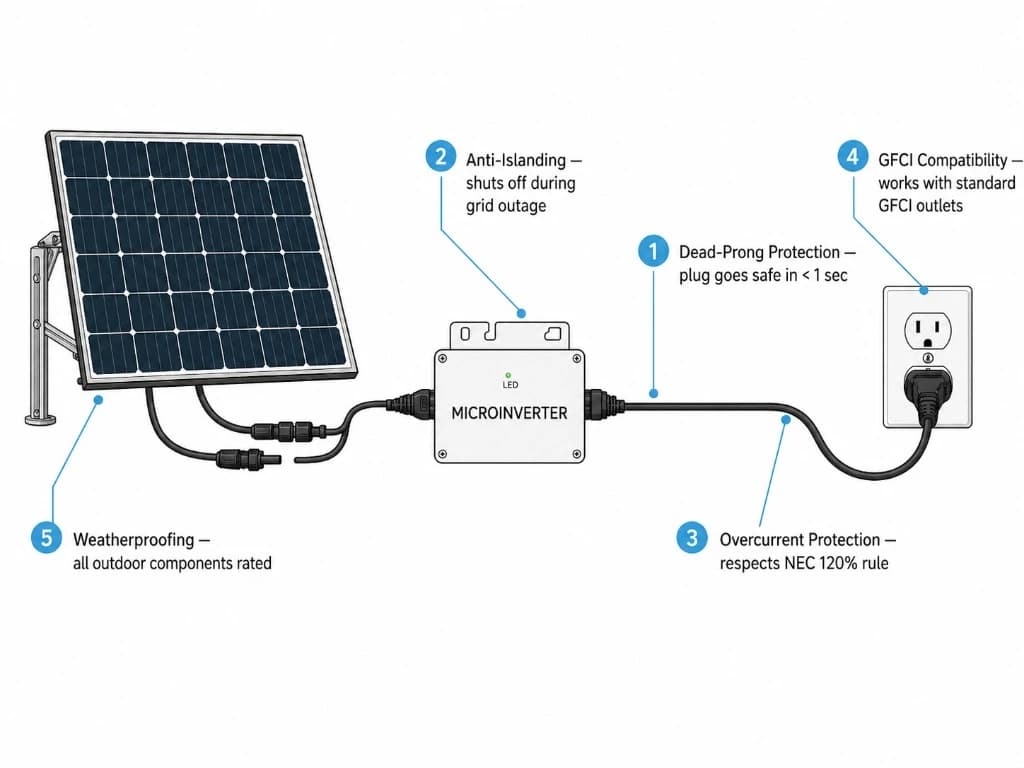
UL 3700 defines five core safety requirements for a complete plug-in solar system. Each one addresses a real failure mode, not a theoretical scenario.
1. Dead-Prong Protection (Rapid De-Energization)
If you unplug the system in midday sun, the metal prongs cannot stay live in your hand. UL 3700 requires the plug side of the cable to go electrically dead within one second of disconnection.
The APsystems EZ1-LV microinverter builds this into hardware. APsystems says the EZ1 is CSA Certified to UL 3700, and it's been available in Maine and select markets since early 2026. When it loses the reference signal from the outlet, it de-energizes the plug side of the cable almost instantly. Earlier-generation products left the cable hot for as long as sunlight hit the panel.
2. Anti-Islanding Protection
During a blackout, the solar system cannot keep pushing power onto lines that crews are trying to repair. UL 3700 requires shutdown within the timeframe defined by IEEE 1547-2018, fast enough that utility workers do not encounter a backfeeding system on the lines they're working on.
Anti-islanding is already required by UL 1741 for microinverters. What UL 3700 adds is verification at the system level, including the cable and plug connection rather than just the inverter board in isolation.
3. Overcurrent Protection
If a circuit is already carrying a room's normal load, plug-in solar cannot quietly push it past the wiring limit. NEC 705's “120% rule” caps how much back-fed power a branch circuit panel can accept. A system that ignores this limit can force a panel busbar to carry more current than its breaker is rated for, which is rare but serious enough to create a real fire risk.
4. Ground-Fault Protection (GFCI Compatibility)
A bathroom or patio outlet protected by a GFCI still has to recognize a genuine fault even when solar is backfeeding through it. UL 3700 requires the system to work correctly with standard GFCI-protected outlets and not confuse their fault-detection logic.
This requirement is genuinely new. No prior US standard for inverters or solar panels addressed how those products interact with GFCI devices in the backfeed direction.
5. Weatherproofing and Mechanical Durability
A balcony cable or inverter does not get treated like indoor gear. Every component that lives outdoors, including the microinverter, the cable, and the outdoor connector, must meet defined weatherproofing and mechanical performance thresholds. A microinverter mounted on a balcony railing is exposed to years of UV radiation, rain, and temperature cycling from −4°F to 140°F in some climates. UL 3700 sets minimum performance standards for each condition, covering the entire system rather than just the inverter enclosure.
How Is UL 3700 Different from UL 1741?
UL 1741 certifies the inverter. UL 3700 certifies the whole outlet-connected system.
| Category | UL 1741 | UL 3700 |
|---|---|---|
| What it covers | The inverter (one component) | Plug-in PV equipment and systems, including cable and plug |
| Designed for | Professional, hardwired rooftop solar | DIY, outlet-connected plug-in solar |
| Dead-prong protection | Not required | Required (prongs go safe in <1 second) |
| GFCI compatibility | Not addressed | Required |
| Anti-islanding | Required (inverter-level) | Required (system-level) |
| Weatherproofing scope | Inverter enclosure only | All outdoor components |
| Status as of 2026 | Established, widely certified | Certified products shipping since July 2026 |
UL 1741 was not wrong for its intended purpose. A microinverter certified to UL 1741 SB meets the grid-connection safety requirements for the inverter itself. What UL 3700 adds is coverage of everything surrounding that inverter: the cable you handle, the plug you touch, the outlet connection that ties the solar system to your home's wiring.
That gap is exactly what created regulatory ambiguity around plug-in solar in the US. A rooftop solar installer never handles a live cable. A renter on an apartment balcony does. If you want to understand whether it's safe to plug solar panels into a wall outlet, that article covers the full certification picture from the buyer's perspective.
What Does UL 3700 Mean for Shopping Right Now?
UL 3700-certified hardware reached the market in July 2026, though most microinverter brands are still working through UL 1741 SB as their baseline. Here's the practical buyer's checklist for right now.
Get notified as new UL 3700-certified products become available
The first UL 3700-certified microinverter is already on the market, and more are on the way. Join the list and we'll email you as new certified products launch.
No spam. Just an email when a new certified product launches.
Best available: a UL 3700-certified microinverter
The APsystems EZ1 is CSA Certified to UL 3700, so it clears both the UL 1741 baseline and the newer dead-prong and GFCI requirements. It runs $325 as of August 2026, and the APmeter ($90) adds zero-export control if your utility requires it.
Still fine: a UL 1741 SB-certified microinverter
Any kit with a UL 1741-listed microinverter meets the inverter-level safety requirements. Enphase and other established brands make UL 1741-certified microinverters. This doesn't give you dead-prong protection or verified GFCI compatibility, but it means the core grid-connection protection has been independently tested.
Red flag: no certification at all
The bigger risk isn't the gap between UL 1741 and UL 3700. It's products with no certification whatsoever, particularly microinverters from budget Amazon listings showing no UL, ETL, or equivalent mark. These haven't been tested for anti-islanding or any other safety function. For the full picture on what uncertified products actually risk, read our plug-in solar safety guide.
What's coming next
Hoymiles announced its HiFlow Pro microinverter on July 15, 2026 and describes it as UL 3700-compliant, though it hasn't published US pricing, a retailer, or a ship date. Craftstrom and EcoFlow are also actively engaged with the US market. Ask any brand whether their microinverter carries UL 1741 SB certification today and whether they've published a UL 3700 testing timeline. Companies serious about compliance are generally willing to say where they stand.
Want to see what a plug-in solar system would save you before deciding which to buy? Try our free savings calculator →
Does Your State Require UL 3700 Certification?
No US state currently mandates UL 3700 certification as a condition for plug-in solar installation. The standard is too new for state legislatures to have incorporated it.
What states are doing is passing laws that permit plug-in solar and referencing existing safety standards as the compliance baseline. Utah's HB 340, the first plug-in solar law in the country, points to UL 1741 compliance as the requirement for systems installed under the law. California's SB 868, which cleared committee on a 14-0 vote, is expected to include equivalent language when finalized. Maine's law takes effect in July 2026 and has already attracted the APsystems EZ1 microinverter, now CSA Certified to UL 3700, to the state market.
Several other states have enacted or advanced plug-in solar laws citing the same certification baseline since: Colorado, Virginia, and New York, while Washington's 2026 bill was stripped by the Senate before reaching a final vote.
Now that UL 3700-certified products are reaching the market, state laws are expected to update their certification references over the coming legislative cycles. That transition gives state legislators a clean, purpose-built certification to cite rather than adapting UL 1741 (a rooftop solar standard) to cover a different product category.
Before you install anything, confirm whether your state requires more than the equipment itself — our guide to permits and utility approval for plug-in solar covers that. And if you're planning to do the work yourself, our DIY installation guide covers exactly when you might still want an electrician.
Frequently Asked Questions
Common questions about UL 3700 certification and plug-in solar safety standards.
Get notified as new UL 3700-certified products become available
The first UL 3700-certified microinverter is already on the market, and more are on the way. Join the list and we'll email you as new certified products launch.
No spam. Just an email when a new certified product launches.
Compare UL 3700-certified plug-in solar hardware
The APsystems EZ1 is UL 3700-certified and shipping now. Estimate what a system like it would save you with our calculator, or browse it alongside UL 1741-certified kits.
We may earn a commission when you purchase through these links — it doesn't affect the price you pay. See our full disclosure →
Last updated: August 1, 2026. Information on this page is reviewed quarterly for accuracy.