Why Is Balcony Solar Everywhere in Germany but Almost Unknown in the US?
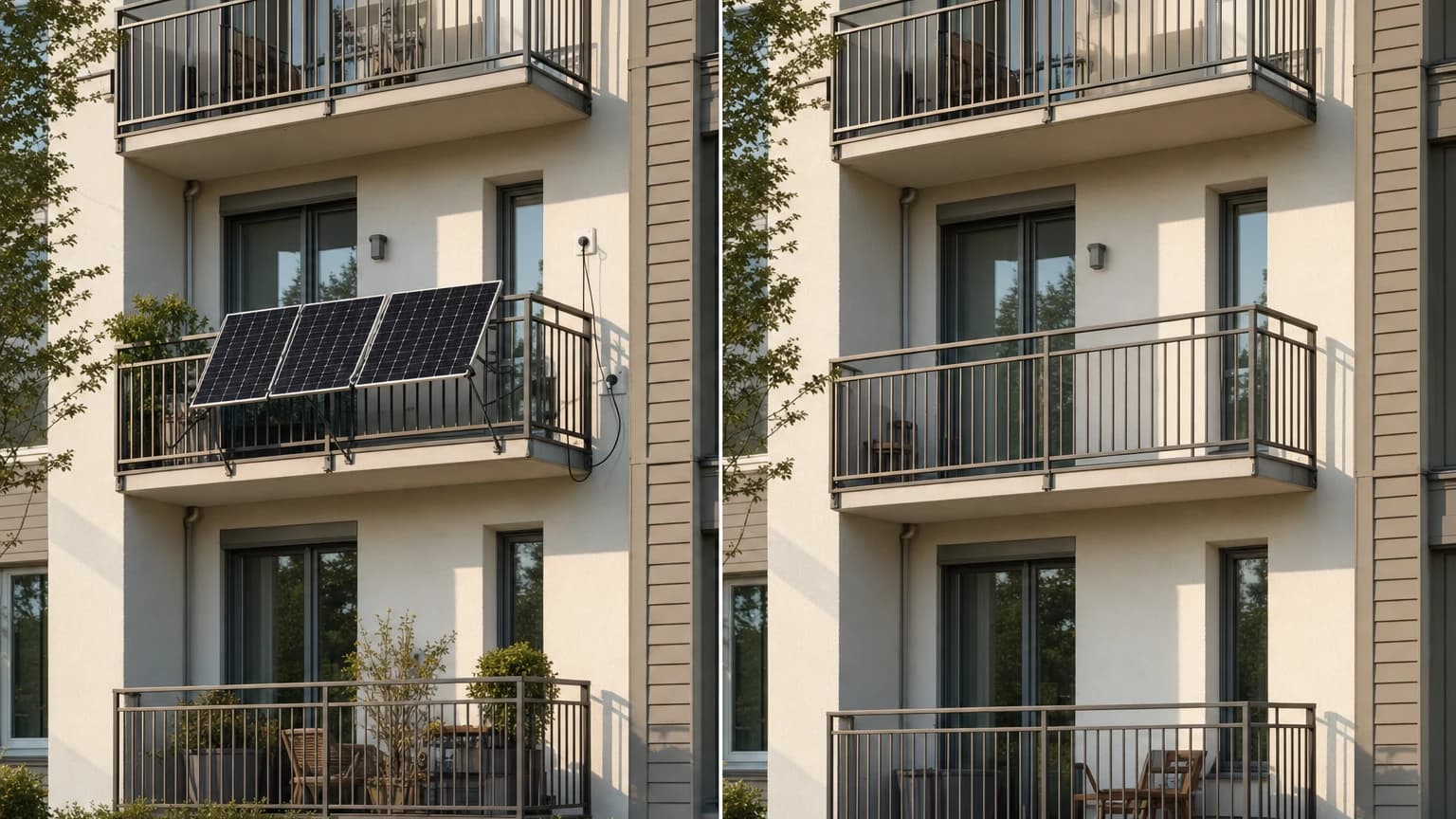
Germany has more than a million balcony solar systems installed — on apartment buildings, terraces, sheds, balconies, anywhere there's a sunny spot and a standard wall outlet. Americans are just now discovering they can do the same thing. The answer isn't that Germany is more “solar-friendly.” It's that Germany made a deliberate choice about who gets to decide whether you can plug something into your outlet — and the US has been making the opposite choice, one that's finally changing in 2026.
What Makes Germany's Balcony Solar Adoption So Far Ahead?
Germany has more than 1 million balcony solar systems because it created a simple rule in 2019: plug-in systems under 600W don't need utility permission. The US applied large-system rules to small ones, and a compatible safety standard — UL 3700 — didn't exist until January 2026. That seven-year gap is almost entirely a policy gap, not a technology gap.
More than 1 million Balkonkraftwerk systems are registered and operating across Germany, according to Germany's Federal Network Agency. The real number is likely higher when you count delayed registrations and unreported installations. These systems collectively produce around 700 megawatts of power — roughly enough to run 200,000 homes.
The growth happened fast. In the first four months of 2026 alone, Germans installed 135,000 new systems — 36% more than in the same period a year before. Cost is the driver. Germany's electricity costs roughly 27 to 35 cents per kilowatt-hour (Eurostat), about double the US national average. When your bill is that high, a €200 ($220) plug-in solar kit that pays for itself in two and a half years is an obvious move. Renters and apartment dwellers (roughly 30% to 40% of Germany's housing stock, per Destatis) finally had a way to access solar without begging a landlord or financing a rooftop installation.
But pricing alone doesn't explain why Americans haven't caught up. California and Hawaii pay 18 to 23 cents per kilowatt-hour. Yet you won't find balcony solar on California apartment buildings. That gap comes down to regulation. Estimate your own payback at your electricity rate →
How Germany Solved the Plug-in Solar Puzzle
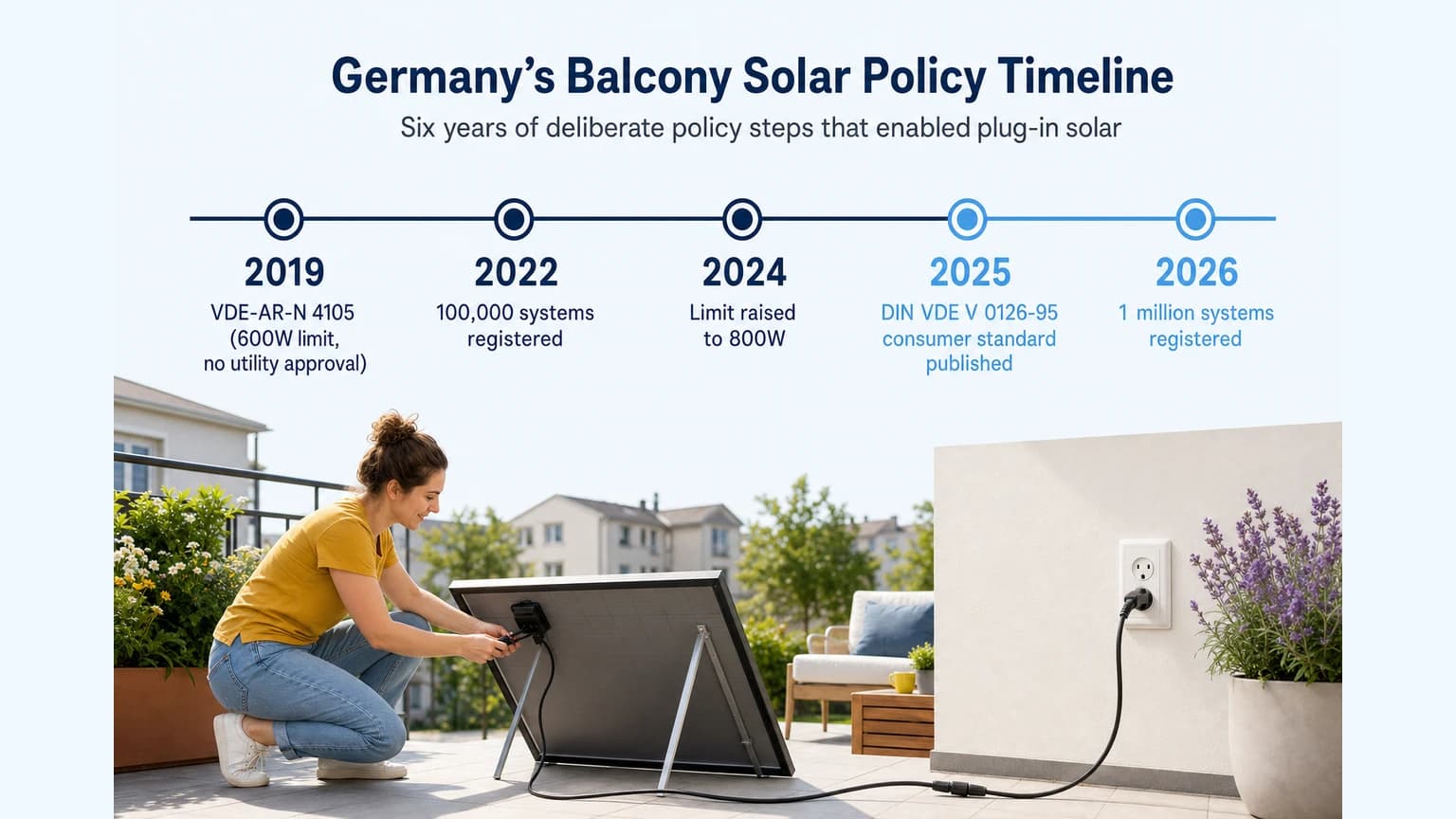
In 2019, Germany passed the VDE-AR-N 4105 technical framework. It made one specific determination: small plug-in solar systems don't need to follow the same rules as large rooftop installations.
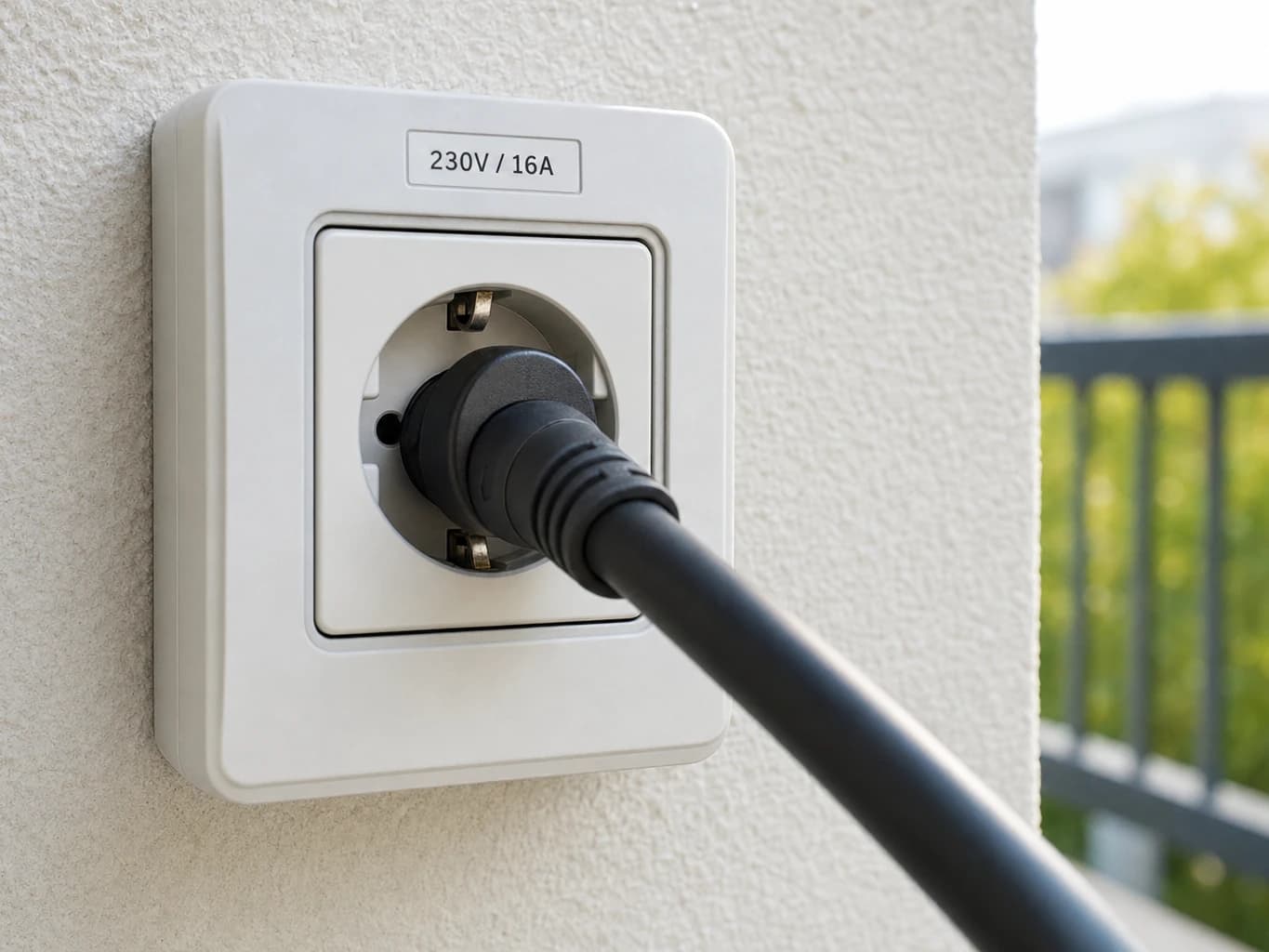
If your system is 600 watts or smaller and you're plugging it into a standard household outlet (a Schuko socket, the Type F plug standard throughout Europe), you don't need to ask your utility for permission. No special agreement. No electrician. You plug it in and it runs.
IKEA started selling complete balcony solar kits for €200 to €400. Hardware stores stocked them. Renters could do this without permission from anyone but their landlord.
In May 2024, Germany raised the limit from 600 watts to 800 watts. Still no utility approval required. In 2025, the German standards body released the DIN VDE V 0126-95 product standard, defining exactly what a plug-in solar device needs to qualify as safe and compliant. Engineers and manufacturers worked together to formalize a standard for a technology already running in millions of homes.
The core insight: a 600-watt balcony system is a consumer appliance, not a mini rooftop installation. You connect it, it runs, and when you unplug it the prongs go dead within a second. Germany was the first country to draw that line in regulation — and drawing it turned balcony solar into a mass-market product almost overnight.
The Infrastructure Advantage: Why 230V Made the Difference
The 120-volt wrinkle is the part most explainers skip over, but it's the reason the US safety work took six years longer than Germany's.
Germany's residential grid runs on 230 volts, single-phase power. A plug-in solar microinverter converts your panels' DC output to 230V AC that matches the home's system. The voltage, frequency, and grid connection type all align. Feed some production back through the outlet circuit and the numbers work without special intervention.
The United States runs on split-phase power: 120 volts for standard outlets and 240 volts for large appliances on dedicated circuits. When a microinverter feeds power back into a 120V outlet circuit, it creates what engineers call reverse backfeed — and that requires safety systems Germany's infrastructure simply didn't need at the same level.
US systems needed microinverters that detect grid outages and shut off instantly to protect utility workers (anti-islanding, per IEEE 1547). They needed dead-prong protection, meaning the prongs de-energize within a second when you unplug the system. They needed overcurrent monitoring and ground-fault detection. None of those requirements are technically difficult, but they needed to be standardized: defined in writing, tested against, and packaged into a certification mark that retailers and legislators could reference.
That certification mark is UL 3700, released in January 2026. Germany's equivalent framework was finalized in 2019. Seven years is most of the gap. Germany's 230-volt infrastructure made the physics intuitive. The US's 120-volt split-phase setup introduced legitimate engineering questions that required a dedicated standard — and that standard didn't exist until last year.
Why Did the US Get Stuck in Red Tape?
While Germany was running balcony solar systems at scale, the United States applied large-system rules to small ones.
In 49 states, your utility controls whether you can connect anything solar to the grid. To plug in a system, you file an interconnection application. The utility reviews it — a process that typically runs 30 to 90+ days. If they have questions, you answer them. If they want more documentation, you supply it. The whole time, your panels sit in a box. What those permits actually require in each state →
That process makes sense for a 10-kilowatt rooftop array feeding power back to the grid all day. For a 400-watt balcony system feeding power to your living room outlet, it's like requiring a building permit to install a ceiling fan.
Utilities point to safety concerns. But IEEE 1547 (the anti-islanding standard) and UL 3700 (finalized January 2026) address every specific technical issue: anti-islanding, dead-prong protection, overcurrent monitoring, and ground-fault detection. The technical objections have technical answers.
A plug-in solar system feeds power directly to your home, not back to the utility grid. That removes the utility from the equation entirely. They can't charge interconnection fees or set the approval timeline. And if your plug-in solar reduces your electricity consumption, that's revenue they don't collect. Utilities in states from Oregon to New York have filed objections to plug-in solar legislation, citing safety concerns. They haven't proposed technical fixes. They've proposed delays.
Is Balcony Solar Safe? (It Didn't Stop Germany.)
Europeans have been running plug-in solar systems safely for over a decade. Germany alone has more than a million of them. In 25 of the EU's 27 member countries, plug-in solar is legal. If there were a safety epidemic, we'd know by now.
The data backs that up. Microinverters from established manufacturers fail at under 0.055% per year, according to Solar Insure claims data. String inverters on rooftop systems fail at 0.89% per year. Plug-in systems are more reliable than the rooftop alternative.
Plug-in solar isn't risk-free. But no US fatality has ever been attributed to a certified plug-in solar system, and Germany's one-million-installation track record shows that systems built to modern specifications do what they're designed to do. The full breakdown of what makes a system safe →
What UL 3700 Requires for Any Certified US System
Dead-prong protection
The plug prongs de-energize in less than one second when disconnected. You won't get shocked touching them.
Anti-islanding
If your home loses grid power, your system shuts off within one to two seconds. It won't accidentally energize the grid and shock a utility worker.
Overcurrent protection
If something goes wrong with the current flow, the system detects it and stops.
Ground-fault protection
If electricity leaks where it shouldn't, the system cuts power immediately.
Weatherproofing
All electrical connections are sealed against moisture and elements.
Germany built millions of systems meeting these specifications before UL 3700 existed. The safety record held.
What's Changing for Plug-In Solar in the US Right Now?
Utah became the first state to legalize plug-in solar in March 2025. House Bill 340 allows systems up to 1,200 watts without utility approval and without an interconnection application.
Utah's move triggered a wave. As of April 2026, roughly 30 states have introduced similar legislation. Maine's law takes effect July 2026. Colorado enacted HB26-1007 in April 2026, creating two tiers: a 395-watt tier (no electrician, no permit) and a 1,920-watt tier (requires a licensed electrician and a dedicated circuit).
Virginia and Maryland have also enacted laws. New York, Pennsylvania, New Hampshire, Minnesota, and Vermont are actively considering them. California, the single biggest potential market with 14 million rental units and high electricity costs, is working on its Plug Into the Sun Act (SB 868), which would expand renter access significantly.
Every one of these states is copying the same approach: cap the wattage at a reasonable level for the outlet type, skip utility approval, and let safety standards do the work.
Manufacturers are moving in parallel. APsystems certified its EZ1 to UL 3700 in July 2026 (the first plug-in solar product to do so), and Hoymiles has announced a UL 3700-compliant HiFlow Pro. EcoFlow, Enphase, and others are still running certification tests. UL 1741 SB-compliant systems remain the current legal path in states that have enacted laws, with 400W starter kits starting around $400 and 800W systems in the $600–$900 range. Browse US-available systems →
The retail bottleneck is starting to clear. APsystems' EZ1 is UL 3700-certified and available directly from the brand, though Home Depot and Costco haven't added plug-in solar to shelves yet. Broader retail carry is expected as more products complete certification and states finish rulemaking.
Why Will the US Eventually Catch Up to Germany on Balcony Solar?
Germany crossed 100,000 registered balcony solar systems in 2022. Two years later it was past a million — a tenfold increase in 24 months. The US crossed roughly 10,000 systems in late 2025, which is about where Germany stood in 2019.
The conditions that drove Germany's growth are now arriving here: enabling legislation (30 states and counting), a consumer safety standard (UL 3700), and about 43 million renters (U.S. Census Bureau) who can't access rooftop solar. Community solar programs exist, but they require subscribing to a utility partner's program. Balcony solar is different. It's your system, on your property, reducing your bill directly without utility involvement.
Germany didn't have some special advantage in sunshine or equipment cost. They decided that small balcony solar systems are a different product category than large rooftop installations and regulated them accordingly. The US is making that same decision, six years later. If you're in Utah, Maine, Colorado, Virginia, or Maryland, you can install a balcony solar system today without utility approval. Check whether your state has enacted plug-in solar laws →
Frequently Asked Questions
Common questions about Germany's balcony solar lead and what it means for the US.
Ready to see if plug-in solar makes sense where you live?
Enter your zip code and monthly electricity bill. Our calculator uses real solar data for your location to estimate your savings — the same calculation German consumers have been doing since 2019.
Last updated: May 2026. Information on this page is reviewed monthly for accuracy.