Can You Plug Solar Panels Into a Regular Outlet?
If you've seen warnings about "suicide cables," the missing detail is the microinverter. A certified plug-in solar kit uses one to match your home's AC power, watch the grid, and shut off fast if the outlet loses power.
Can You Plug Solar Panels Into a Wall Outlet Safely?
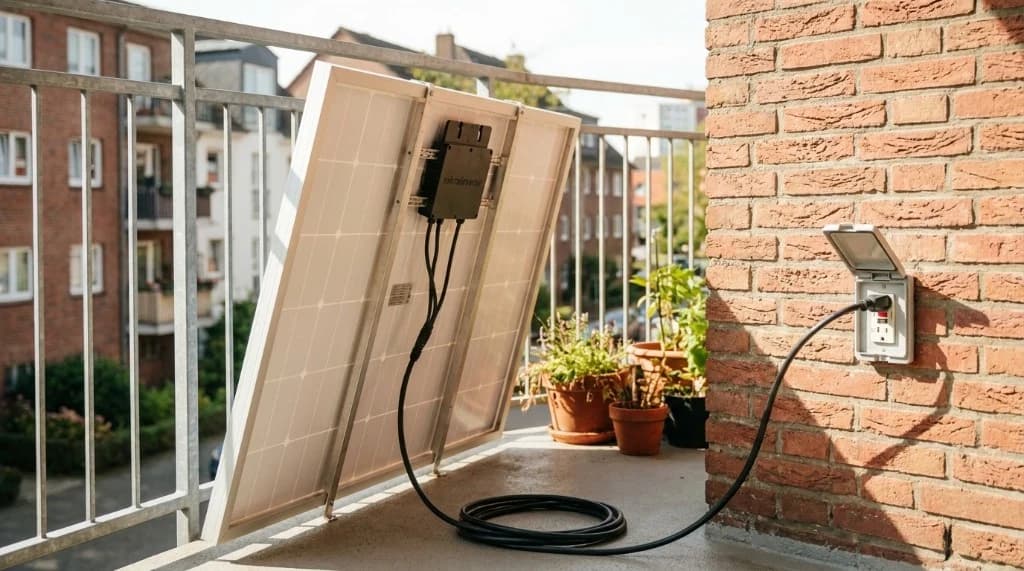
You can plug solar panels into a regular 120V household outlet when the system uses a grid-tie microinverter that meets US safety standards. The microinverter converts DC to AC, syncs with your home's grid, and shuts itself off the instant that grid signal disappears.
If you skip the microinverter and try to wire a bare panel to a plug, you get something dangerous that has nothing to do with real plug-in solar. The microinverter is the product. The panel is just the fuel.
Here's what happens in sequence when you plug a certified system in:
- Sunlight hits the panel and produces DC electricity.
- The microinverter turns DC into 120V AC that matches your home's 60 Hz grid signal.
- The plug sends that AC into your home circuit, where your appliances use it before drawing from the grid.
- If the grid ever drops, the microinverter senses it in under a second and de-energizes the plug.
Want to see what a system like this would save you in your zip code? Try our savings calculator.
What Does the Microinverter Actually Do?
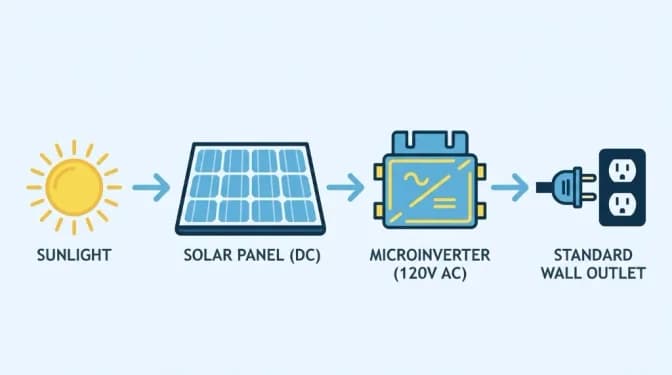
The hard part is not getting electricity out of the panel. The hard part is turning that raw DC power into the same kind of 120V AC your house already uses, then shutting it off the moment the outlet no longer sees the grid. That is the microinverter's job.
Most microinverters are small weatherproof boxes mounted behind the panel or right next to it. Inside, they take the panel's DC output and shape it into a clean AC waveform that matches your home's voltage and frequency. If the signal does not line up with the grid, the unit stops instead of guessing.
At the same time, the microinverter keeps checking the outlet side of the connection. It watches voltage, frequency, and overall grid health hundreds of times a second. It only sends power when the grid looks stable on the other side of the plug.
Once your panel is producing, the electricity flows into your home circuit. Your appliances draw from it first because it's the closest source. In most plug-in setups, excess beyond what the house is using does not get exported to the utility. It is used locally or curtailed.
This is the same category of hardware used on multi-panel rooftop systems. The engineering is not experimental. It has been field-tested for more than a decade on hundreds of thousands of rooftops. If you want the hardware-only explainer, start with our guide to what a microinverter is. For the broader system walkthrough, See our full guide on how plug-in solar works.
What Stops Plug-In Solar From Backfeeding the Grid?
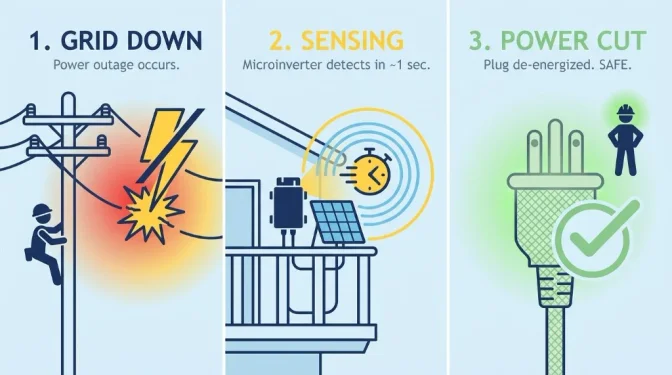
Picture a neighborhood outage while a line worker is repairing what should be a dead wire. If a solar setup kept pushing power backward through the outlet and into the grid, that line could stay live.
That is the scenario anti-islanding is built to prevent. Without it, exposed prongs could stay live after unplugging, and electricity could feed backward into utility lines, creating an "island" of energized wire in a neighborhood the utility believes is shut down.
Anti-islanding makes the problem disappear. The microinverter watches the grid's voltage and frequency hundreds of times a second. The instant it loses that signal, it stops producing and de-energizes the plug. The industry spec, IEEE 1547, requires the shutoff to happen in under one second. Most modern microinverters do it in a few hundred milliseconds.
The other real risk: breaker masking
Anti-islanding covers the "live prong" problem, but there's a second risk worth understanding: breaker masking. Your home's circuit breakers trip when too much current flows through them. But a breaker only sees the net current passing through it, the difference between what your appliances pull and what your solar pushes in.
If a plug-in solar system is feeding 600W into a circuit while your appliances draw 1,400W, the breaker only "feels" 800W. You can quietly overload the circuit without the breaker ever complaining, and the wires behind your drywall can overheat.
This is the exact reason the US created its first dedicated plug-in solar safety standard, UL 3700, which launched January 8, 2026. Certified kits under UL 3700 must include:
- Automatic cutoff if the plug is disconnected
- IEEE 1547-level anti-islanding
- Active overload monitoring that throttles or shuts down the system if the total circuit load approaches what the wiring can safely handle
A simpler day-one protection: plug the system into a dedicated outlet on its own circuit, not a strip shared with a space heater and a microwave.
Breaker masking is just one of several electrical risks worth understanding before you buy. For the complete picture, including anti-islanding, dead-prong protection, and a full buyer's checklist, see our guide to whether plug-in solar is actually safe.
Why Isn't a Certified Kit the Same as a "Suicide Cable"?
Search "plug a solar panel into an outlet" and you'll run into angry electricians warning about "suicide cables." They're not wrong, but they're talking about something completely different from a certified plug-in solar kit.
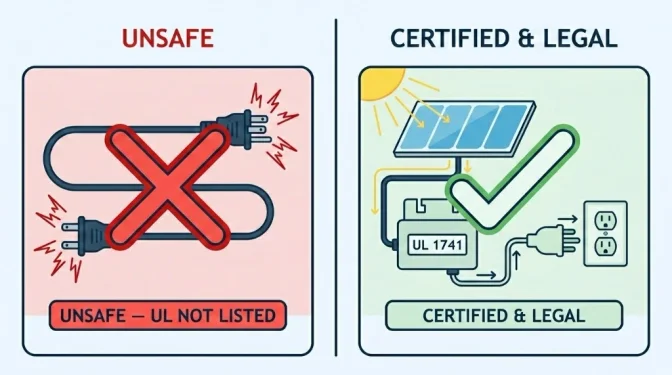
A suicide cable is a male-to-male extension cord with a bare solar panel wired to one end. There is no grid-monitoring hardware, no anti-islanding, and the exposed male prongs are live whenever the panel produces. It absolutely should be avoided.
A certified plug-in solar system can look superficially similar, but under the hood it is a completely different product:
| Suicide Cable | Certified Plug-In Solar | |
|---|---|---|
| Grid-monitoring hardware | None | Microinverter reading voltage and frequency continuously |
| Anti-islanding shutoff | No | Yes — under 1 second, per IEEE 1547 |
| Exposed prongs when unplugged | Live | Fully de-energized |
| Overload monitoring | No | Required under UL 3700 |
| Legal under US codes | No | Yes, in states with enabling legislation |
When electricians say "never plug a solar panel into your wall," what they really mean is "never plug a bare, uninverted panel into your wall." That's correct. A certified plug-in solar kit doesn't violate that rule because a certified kit isn't a bare panel. It's a complete, monitored, shutoff-equipped microinverter system that happens to end in a plug.
Is It Legal to Plug Solar Into a Wall Outlet in Your State?
The hardware is safe. Whether it's legal where you live is a separate question, and the answer genuinely depends on your state.
The root issue is the National Electrical Code. NEC Article 690 requires any power-production equipment to be on a dedicated branch circuit and documented in the permanent electrical plan. A growing number of states have passed enabling legislation creating a specific carve-out: if the system is certified, size-limited (usually 800W–1,200W), and connected to a suitable outlet, it's legal without a permit or a licensed electrician.
Even where plug-in solar is legal to own, some states still expect a notification step or paperwork before you plug in. Our guide to permits and utility approval for plug-in solar breaks down exactly what's required (usually nothing, but it's worth checking). The concept itself isn't new, either — Germany's balcony solar market has operated under a similar legal framework for years, and the US is only now catching up.
Check your state's status
The regulatory map shifts as bills move through committees. For the full breakdown including status, bill numbers, and what each state's rules mean for renters, apartment dwellers, and homeowners — including balcony solar placement — see our state-by-state legality guide.
View state-by-state legality guide →How Much Can You Actually Save?
A standard 800W plug-in solar system generates roughly 80–120 kWh of electricity per month in an average US location, enough to cover the base load of a small apartment: your fridge, router, a few lights, and your phone charger running 24/7.
| Your rate | Monthly bill savings | Annual savings |
|---|---|---|
| $0.13/kWh (low-cost states) | ~$13–16/mo | ~$155–190/yr |
| $0.17/kWh (US average) | ~$16–20/mo | ~$195–245/yr |
| $0.30/kWh (CA, HI, NE states) | ~$30–40/mo | ~$360–480/yr |
| $0.42/kWh (peak HI/CA rates) | ~$40–50/mo | ~$480–600/yr |
Two details change the numbers a lot. First, orientation: a south-facing panel with no shade produces roughly 30% more than an east or west mount. Second, timing: plug-in solar is most valuable when you're actually using the electricity in real time, because excess typically isn't exported to the utility.
For a number that reflects your actual zip code, panel orientation, and local utility rate, use our savings calculator. It pulls real solar irradiance data for your location and gives you a monthly and annual estimate in about thirty seconds.
What Should You Look for in a Plug-In Solar Kit?
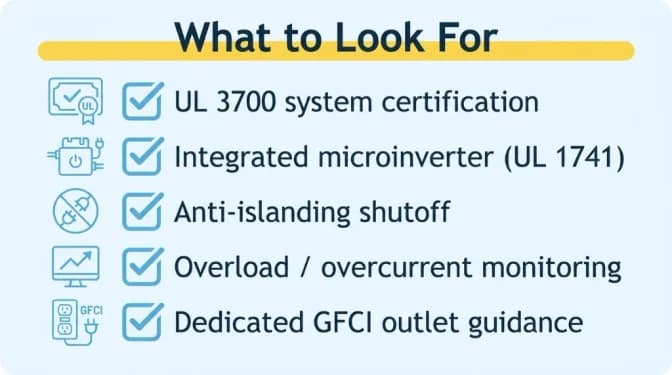
We may earn a commission when you purchase through these links — it doesn't affect the price you pay. See our full disclosure →
UL 3700 certification
Look for UL 3700 on the system, or UL 1741 on the microinverter plus an explicit overload-monitoring feature. This is the single most important line on the spec sheet.
A certified microinverter
Not a DC-only converter or a "plug-and-play" battery bank pretending to lower your electricity bill.
Named manufacturers: APsystems (EZ1-LV), EcoFlow (STREAM Microinverter), Hoymiles, or Craftstrom.
Anti-islanding listed in the spec sheet
Ideally with IEEE 1547 or UL 1741 referenced by name.
Size that matches what your state allows
Most enabling laws cap output at 800W–1,200W. An 800W kit fits almost every enabling law. Oversized kits can be legal to own but not legal to connect.
A real warranty and US-based point of contact
Microinverters are expected to last 15–25 years. You want a company that will still exist when yours eventually needs a firmware update.
Ready to compare actual systems? Browse our curated product catalog. Every kit we list has been checked against this exact checklist.
If you're unsure whether your balcony, patio, or backyard is suited for a balcony solar setup or a standard plug-and-play solar kit, our installation guide walks through the six most common setups with photos.
Want to understand the differences between plug-in solar and a portable power station before buying? See our plug-in solar vs. portable solar generator comparison.
Frequently Asked Questions
Common questions about plugging solar panels into a regular outlet.
Ready to see how much plug-in solar could save you?
Enter your zip code and monthly electricity bill. Our calculator uses real solar data for your location to estimate your savings.
Last updated: April 22, 2026. Information on this page is reviewed quarterly for accuracy.